
Alamy announced changes to its contributor contract on 13 July 2026 in a blog post titled “Building a Stronger Alamy for the Future.” The revised commission rates will take effect on 1 September 2026.
The company points to the rapidly changing visual-content market, evolving customer expectations, growing investment by competitors and the impact of AI on how customers search for and license content. Although the statement fails to mention how cameras, software, insurance, travel and production costs are also rising for contributors.
Unfortunately, Alamy’s proposed solution includes reducing the commission paid to a significant group of contributors. Here’s a summary:

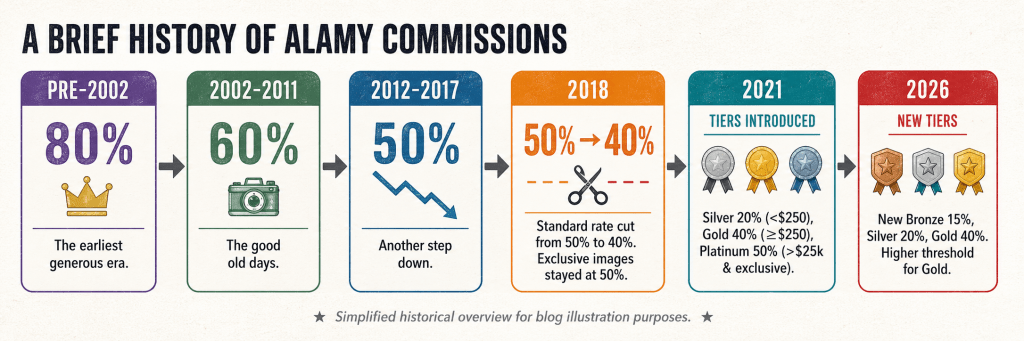
The existing Silver, Gold and Platinum structure is being replaced by Bronze, Silver and Gold, with new qualifying thresholds and contributor shares. In this post, I will break down what the changes mean in practice, using my own Alamy earnings as an example. Let’s get started.

Alamy Olympics Recap from 2018
Alamy’s contributor commission history needs a little context. Some genuine Alamy old-timers will remember an even more generous era when contributors received 60%.
In 2018, Alamy announced that its standard contributor share would fall from 50% to 40%. Following considerable criticism, images declared exclusive to Alamy remained eligible for 50%, while non-exclusive content moved to 40%.
In 2021, Alamy introduced its formal Silver, Gold and Platinum tier structure. Gold became the standard 40% rate for the vast majority of contributors, while contributors earning less than $250 gross during the relevant 12-month period would be moved to Silver at 20%. A very small group of Platinum contributors generating more than $25,000 gross could continue receiving 50% on qualifying images marked as exclusive to Alamy.

The 2021 changes also removed the general 50% exclusive-content rate. Alamy quickly figured that a “significant minority” of contributors had incorrectly marked images as exclusive or had failed to update their settings after placing the same work elsewhere (later charging administration costs for chasing infringements by a third-party, which won’t be discussed here).
The latest revision effectively replaces Platinum with a reworked Bronze (which might as well be coal), Silver and Gold structure:
| Annual gross licence revenue | Tier | Contributor share |
|---|---|---|
| Below $250 | Bronze | 15% – Ouch!! |
| $250 to below $3,000 | Silver | 20% – Ouch! |
| $3,000 or more | Gold | 40% |
Under the revised contract, the “Revenue Year” means the 12-month period beginning on 1 September and ending on 31 August of the following calendar year.
The new rates take effect from 1 September 2026, rather than applying retrospectively to the whole of 2026. The only real good news I’m afraid.
You can read Alamy’s explanation of the contractual changes here, including other minor changes. Here’s also a more details table on the changes.

When Gold Turns to Silver
Under the previous structure, contributors generating at least $250 in gross annual sales could remain on the 40% Gold rate.
The revised structure raises the qualifying amount for 40% from $250 to $3,000, which is a twelvefold increase. Contributors whose qualifying gross licence revenue falls between $250 and $3,000 will receive 20% rather than 40% from 1 September 2026.
For a contributor with a commercially useful portfolio, reaching $250 gross in sales was relatively achievable. Depending on subject matter, portfolio quality and licence values, it could be achieved with several hundred strong images.
Reaching $3,000 is a very different proposition. It requires regular licensing throughout the year and, for most generalist contributors, probably several thousand commercially relevant images. I for one have never achieved this modest feat.

How many contributors will be affected?
Alamy has not published a breakdown showing how many contributors earn within each revenue band (and never will). Any percentage must therefore be treated as an estimate. Therefore, a plausible distribution across Alamy’s entire registered contributor base might look something like this:
| Annual Alamy gross sales | Estimated share of contributors |
|---|---|
| Below $250 | 70%–80% |
| $250–$3,000 | 15%–25% |
| Above $3,000 | 3%–8% |
| Above $25,000 | Well below 1% |
Based on that estimate, perhaps 15%–25% of all registered contributors could suffer the direct reduction from 40% to 20%.
The proportion among active, regularly selling contributors may be considerably higher, since Alamy’s total contributor population includes dormant accounts and very small portfolios generating few or no sales.
However, it would be inaccurate to claim that 80%–90% of contributors are receiving an immediate royalty cut. Those earning below $250 already receive 15% (giving them motivation to either quit or upload more quality work), while those above $3,000 retain 40%. The direct losers are those positioned between the two thresholds, such as myself (on the top-end of Silver).
That middle group may not represent the majority of all registered accounts, but it likely includes a meaningful number of serious and long-standing contributors.

What the Change Means in Practice
I’ve just checked my earnings from last year’s Revenue Year and I’m afraid that I’ve likely been relegated to Silver and will probably stay there for the time being.

There is a small hope that I’ll be able to generate $870 in the next six weeks though, although August is not traditionally a strong sales month.
Historically it hasn’t looked good as I’ve never surpassed $3,000 gross a year although I came close in 2021.
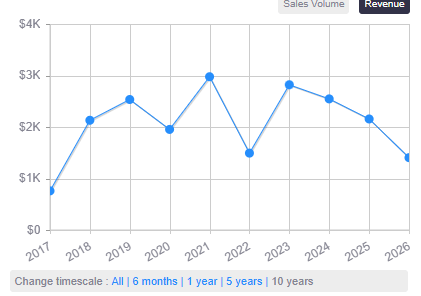
Alamy wants to get rid of small-time casual contributors
Alamy seems to be doing all it can to dissuade small-time contributors from continuing. As well as those that have established portfolios who are not uploading much and living off the “passive income”.
Realistic Projections for 2027
Therefore, let’s consider that I’ll generate $2,500 in gross annual licence revenue in the next Revenue Year.
Previously, at 40%, I would have received:
$2,500 × 40% = $1,000
Under the revised 20% rate, I would receive:
$2,500 × 20% = $500
That is a loss of $500, or a 50% reduction in contributor income (even though the commission fell by 20%), which in a way makes me much more desperate to reach that magical threshold.
At the end of the year it won’t make a huge difference to my bottom line, although always discouraging to see revenues drop with new quality assets. In any case, despite a large portfolio over 17,000 assets (many exclusive), Alamy has never been a large earner for me.
However, just from reading the Alamy Contributor Forum’s respective thread of these changes, there are many contributors who upload exclusively to Alamy. They’re currently venting their justifiable anger and Alamy will have few turbulent days/weeks ahead to try to repair the damage done.

Another Turn of the Microstock Hamster Wheel
This is particularly significant because contributors are already working harder for weaker real returns.
In my recent analysis, Microstock Hamster Wheel: More Files, Fewer Sales, Lower Real Returns—Data Analysis from 2019–2026, I examined how portfolio sizes have increased while sales, average returns and inflation-adjusted income have moved in the opposite direction.
Alamy’s commission adjustment adds another turn to that wheel. Contributors affected by the reduction must now generate around one-third more revenue simply to recover the income they previously earned from the same level of sales.
I’ve adjusted my projections for revenues at Alamy to take into account these changes:

As you can see above, the average returns are starting to look closer and closer to microstock prices, without the volumes.
It’s more of the same really, but I’m having some déjà vu.
We Have Seen This “Exciting News” Before
Ah, that’s right! The changes also bring back unpleasant memories of Shutterstock’s controversial contributor royalty overhaul in 2020, at the height of the pandemic.
You may recall that Shutterstock introduced six earnings levels ranging from 15% to 40%, with contributors climbing through them according to annual download numbers. At the beginning of every calendar year, all contributors were reset to the lowest level and forced to climb again.

I covered the announcement at the time in my May 2020 Brutally Honest Earnings Report and Shutterstock commission analysis.
Alamy’s revised model is not identical, however there are many similarities. Shutterstock bases its levels on download volume and resets contributors annually. Alamy bases its levels on annual gross licence revenue on a dynamic basis.
However, the underlying effect is similar: the headline maximum percentage remains available, but it becomes harder for many contributors to obtain, especially the more casual contributors.
Different system, familiar result: a significant group of active contributors will receive a smaller percentage, while the headline maximum rate remains available but much harder to reach.

The Brutally Honest View
Alamy’s main strengths remain its editorial and news collections, together with its vast archive of authentic photography.

But those strengths do not make the company immune to what I call the AI winter storm (using the Game of Thrones metaphor) currently disrupting the visual-content industry.
AI is changing search, content production and licensing. Customers expect faster results, broader collections and increasingly sophisticated search technology. Alamy must invest to remain competitive.
Once again, part of the cost of adapting the business is being transferred directly to contributors through lower royalties. We have seen this pattern for more than 20 years, but it has accelerated over the past six. Contributors are expected to accept the reduction while continuing to fund their own equipment, insurance, software, travel and production.
Alamy once felt like an alternative to the worst excesses of microstock at least there were some quite impressive sales (much rarer these days).

Alamy was a healthy alternative to micros
So, what is the solution? I must reiterate the conclusion from my recent Hamster Wheel post:
The best work should move away from low-value mass distribution and toward premium or specialist outlets. Even if volumes are lower it should be make up with higher average prices or at worst at least you’re not selling your soul to those devils.
Alamy once felt like an alternative to the worst excesses of microstock. There were at least occasional high-value licences, even if those have become much rarer. But with average licence values already falling and this latest change reducing my contributor earnings by a further 25% I am no longer convinced that distinction still holds.
Shutterstock and Getty built the furnace. Alamy has now decided to help shovel the coal.

About Alex
I’m Alex, eccentric, based in Lisbon, and on a mission to explore every corner of the globe while capturing stock images and footage along the way.
For the past 12 years, I’ve been grinding as a travel photographer/videographer and freelance writer. Along the way I’ve also written The Brutally Honest Guide to Microstock Photography, a book packed with war stories and practical tips for anyone crazy enough to enter this business and more recently, The Brutally Honest Guide to Drone Laws in Europe.




Leave a comment