

Well, that was short-lived. The proposed Getty Images and Shutterstock mega-merger is dead, and the stock photography industry remains exactly where it was before: fragmented, under pressure, and staring nervously at the advancing AI army.
So what happened, and more importantly, what does it mean for contributors?

Shutterstock Stock Bloodbath
Shutterstock investors took the news badly with the stock dropping by 29% and the long-term looking bleak.
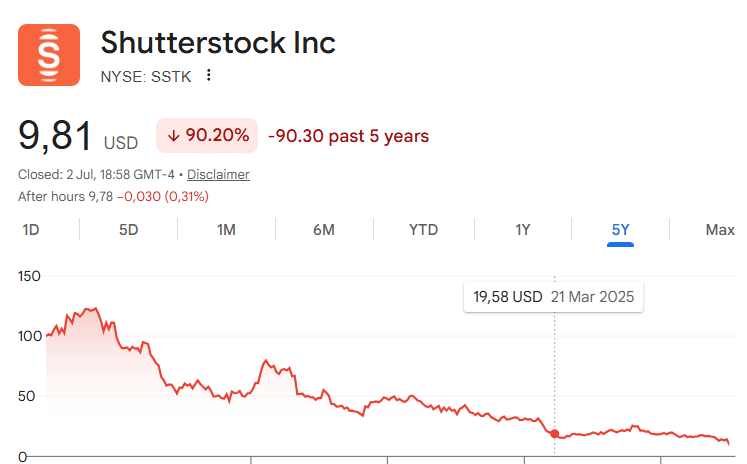
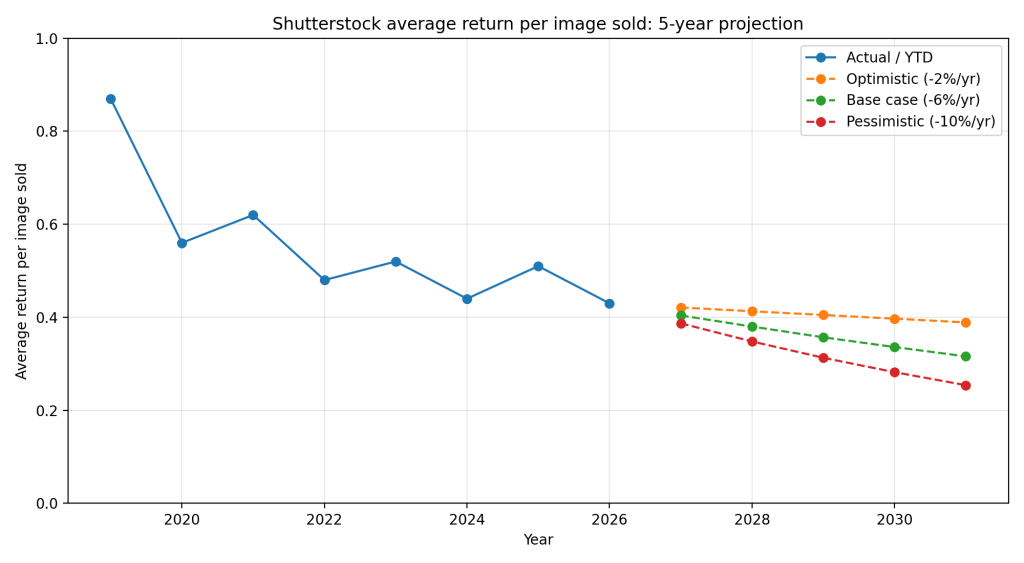
Which, incidentally, looks rather similar to my average return per image on Shutterstock over the same period. In life, sometimes there are no coincidences.
Getty, meanwhile, walked away looking relatively steadier.
This deal would almost certainly have led to savings for both companies, or as executives prefer to call them, “synergies.”
Recap from January 2025
I wrote about the proposed merger back in January 2025, when the deal was first announced. For those who missed it, here is my original take on why Getty and Shutterstock wanted to join forces, and what it could mean for contributors:
Getty, Shutterstock and the AI White Walkers
The failed merger says something bigger about the state of the stock industry. Getty and Shutterstock were not trying to merge because stock photography is booming. Far from it.
They were trying to merge because the traditional stock model is under pressure from all sides, particularly from generative AI.
Let’s not pretend this was some warm creative partnership. These are two long-time rivals, with different cultures, different systems, different contributor relationships, and probably plenty of boardroom distrust.
Which brings me to my slightly nerdy analogy.
The proposed Getty and Shutterstock merger reminded me of Game of Thrones, in particular the great alliance at Winterfell, where centuries-old enemies put aside their hatred to fight the White Walkers (Army of the Dead). They joined forces because the alternative was extinction.
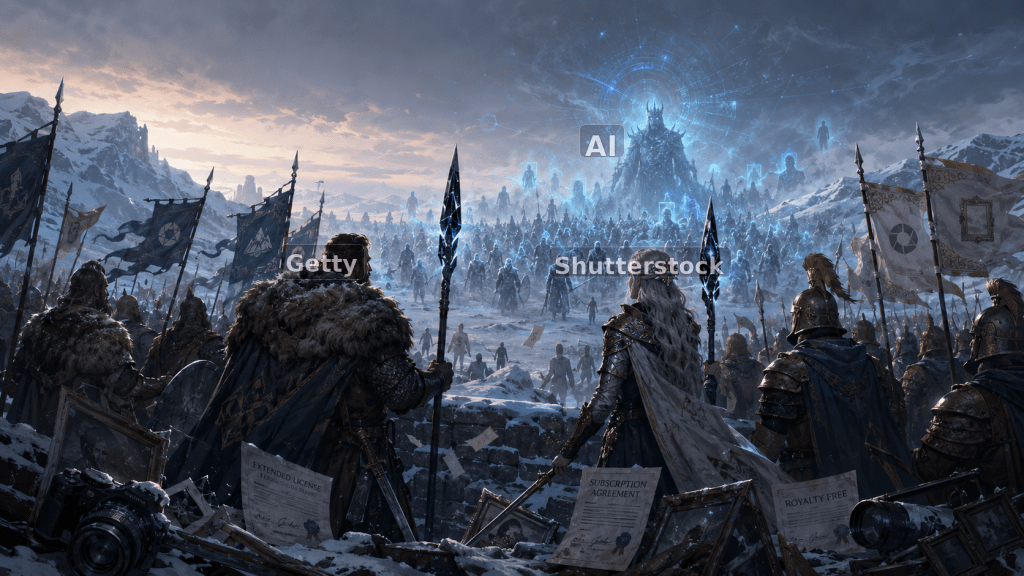
Getty and Shutterstock were looking at their own version of the Army of the Dead. Every generic stock image made worthless by instant prompting only strengthens the forces attacking the old stock model.
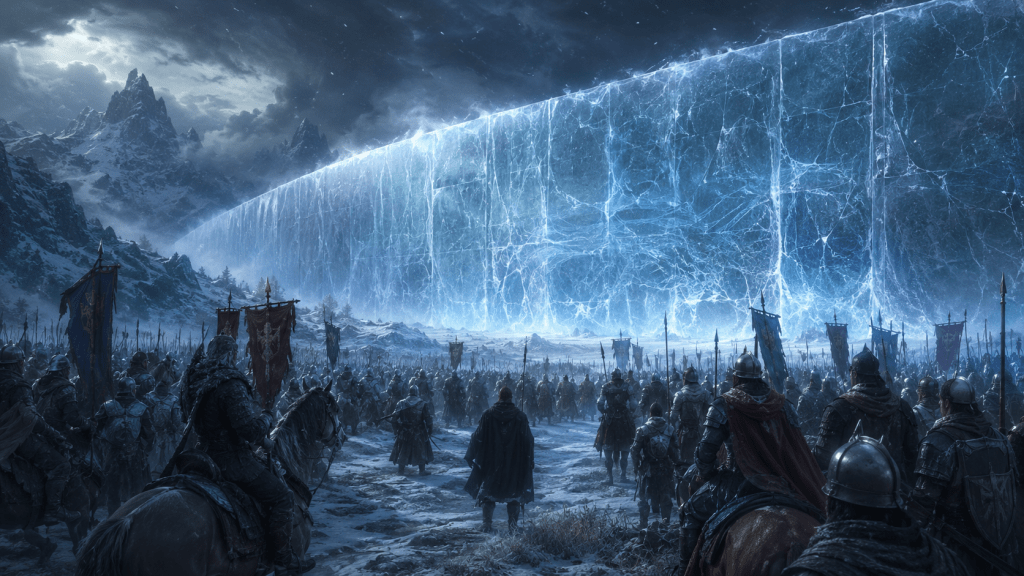
By joining forces, Getty and Shutterstock could have created a much larger defensive wall against AI (which is almost in a satire-type of way generated using AI).
Would that wall have held for long? Of course not but at least it would have bought them some time and combined resources.
Getty partnering with OpenAI
Getty is trying to strengthen its own ice wall. The company recently announced a multi-year display partnership to bring Getty Images’ licensed content into OpenAI search and discovery experiences.
The details remain sketchy, especially around what this means for contributors, but the direction is obvious: Getty knows AI is not going away, so it is trying to position itself as a licensed, legally safer content supplier inside the AI ecosystem.
Four Thoughts for Contributors
For contributors, I see a few practical implications.
1.Lower average earnings are still the long-term trend
I discussed this in detail in my previous post:
The answer, unfortunately, is not simply to upload more. Today, contributors need to specialise, build authority in specific niches, and aim for excellent rankings within those niches.
2. Specialisation matters more than ever
As regular readers know, my own journey has increasingly moved toward two specialised agencies: Arcangel and more recently, Amazing Aerial.
Arcangel remains a fascinating but frustrating journey. I genuinely enjoy creating book-cover imagery because it is more artistic, more conceptual, and potentially higher value than generic microstock.
There is also a legacy element to this as my work will sit at someone’s book shelf for years to come instead of some stupid blog post about nothing that someone purchased using a subscription.
But enjoyment does not cover my travel/gear costs. Despite reaching 6,857 images, sales remain sporadic. That does not mean I am giving up, but it does mean I am no longer pretending that effort automatically equals reward so I may have to scale back.
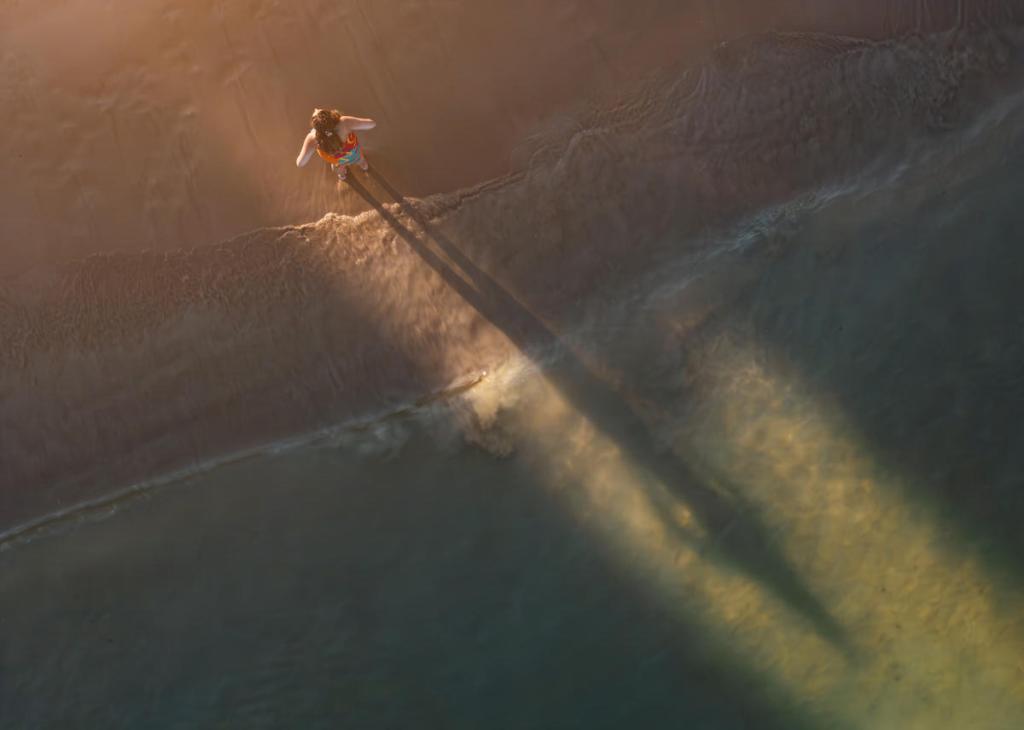
Perhaps the AI revolution is also affecting book cover sales as it’s now quite easy to prompt something that looks like a high-end commercial book cover, although highly unethical. Whether it’s happening in real life needs to be investigated (for another discussion).
Amazing Aerial
Amazing Aerial, on the other hand, is a newer addition for me and has already produced immediate results which helps with motivation. It has quickly become my go-to agency for most of my commercial and editorial content (portfolio at 1,500 now and growing).
Paul Prescott, founder of Amazing Aerial, remains bullish about the future of the agency even in this difficult market. I asked him for his thoughts on the collapse of the Getty/Shutterstock merger, and here is what he had to say:
The news that Getty Images and Shutterstock are ending their proposed merger is another reminder that our industry is evolving at an unprecedented pace.
As AI transforms visual content and the world’s largest agencies search for new ways to adapt, one thing has become increasingly clear:
The future won’t be defined by size alone.
It will be defined by specialisation, authentic content, strong communities, and meaningful relationships with photographers.
This is exactly why we founded Amazing Aerial.
That is obviously a more optimistic take than mine, but I do think he is right on one key point.
Size alone will not save agencies. Specialisation might and that is where I’m headed.
I also asked Hugo Kurk on his thoughts:
My feelings says it’s a good thing the merger did not happen. It would give to much control and influence to one marketplace, in my opinion it’s more healthy to keep the market competetive and diverse. Especially for us contributors. On the other hand I see Shutterstock struggling in the last years, it seem they are not taking the right business decisions and handling out of fear, are they still investing in creating value? Or just competing by lowering prices and trying to take over other parties. The marketplaces they took over seems to turn into decline while others grow. My experience is that Getty seems to follow a good path and Shutterstock seems not.
Steve Heap is an example of excellent specialisation
Steve Heap is a prime example and has specialised in selling fine art prints, check out more on this on his channel.

3. Editorial content still has legs
Editorial may become relatively more valuable. Not necessarily better paid (God-forbid the Left-wing “Guardian of the People” newspaper is one of the worst payers), unfortunately, but more strategically important.
Real-world newsworthy content is much harder to replace with AI. You cannot honestly prompt a real football match, a real protest, a real celebrity appearance, a real court case, a real flood, or a real political event. Bad actors will try, and the problem will only get worse, but that is a discussion for another day.
That is precisely why the UK’s CMA focused so heavily on the editorial side of the Getty/Shutterstock merger. In the end, the requirement to sell Shutterstock’s editorial business appears to have been the condition that killed the deal.
For contributors who produce strong editorial, news, sport, celebrity, travel, drone or documentary-style content, this is probably a green light to keep going.

4. Small generalist agencies look vulnerable
I also expect more consolidation among smaller and mid-tier agencies.
How Depositphotos, Dreamstime, 123RF and similar generalist agencies continue to compete in this environment is beyond me. My sales there have shrunk to occasional beer money at best.
In the near to medium term it is difficult to see how small generalist libraries survive against Adobe, Getty, Shutterstock, direct AI generation and specialist agencies.
But contributors should be realistic. If an agency is producing almost no revenue for you now, ask whether it is worth your time, attention and fresh uploads.
I would also strongly warn against uploading to small agencies that may be struggling, it’s not unforeseeable for them to “garage sale” your images to pay off their debts.

Final thoughts
The good news is that, for the time being, Getty and Shutterstock are still competing against each other.
That avoids the immediate risk of one mega-agency having even more control over buyer relationships, contributor terms, editorial archives, and licensing structures.
For contributors, that is mildly positive, but let’s not celebrate too much as the future for traditional microstock remains bleak.
The Getty/Shutterstock merger falling through does not reverse declining royalties. It simply means one possible defensive wall against AI was never built. And even if it had been built, it was probably only a matter of time before the AI ice wall was breached.
As contributors, the question is whether we are building our own defences, or still uploading generic commercial content blindly into the storm.
I, for one, have chosen to specialise.
Not because it guarantees survival. But because uploading generic commercial content blindly into the storm is no longer a strategy. It is wishful thinking.
Thanks for reading and until next time.
About Alex
I’m Alex, eccentric, based in Lisbon, and on a mission to explore every corner of the globe while capturing stock images and footage along the way.
For the past 12 years, I’ve been grinding as a travel photographer/videographer and freelance writer. Along the way I’ve also written The Brutally Honest Guide to Microstock Photography, a book packed with war stories and practical tips for anyone crazy enough to enter this business and more recently, The Brutally Honest Guide to Drone Laws in Europe.







Leave a comment