
As we are now halfway through 2026, it feels like the right moment to take a step back and look at the bigger picture of my increasingly strained stock photography business.
The situation looks bleak, I won’t sugarcoat it and sometimes I have the urge to just pull the plug / lever on the whole thing.
There are some reasons to be optimistic
But I am not completely pessimistic going forward as the poor performance of traditional microstock is exactly why I feel more confident about the strategy I’ve been implementing for a while: uploading less blindly to low-value agencies and pushing my best work toward more specialist, higher-value outlets.
First, let’s look at the big picture at the micros, starting with images.
Low Royalties + High Volume works
For years, the logic of microstock was simple: relatively low royalties were acceptable because the volume was there.
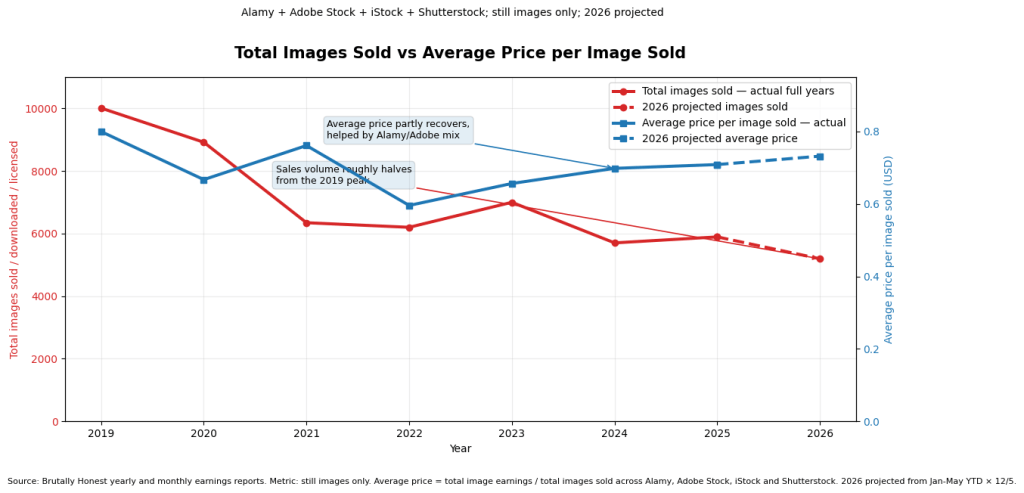
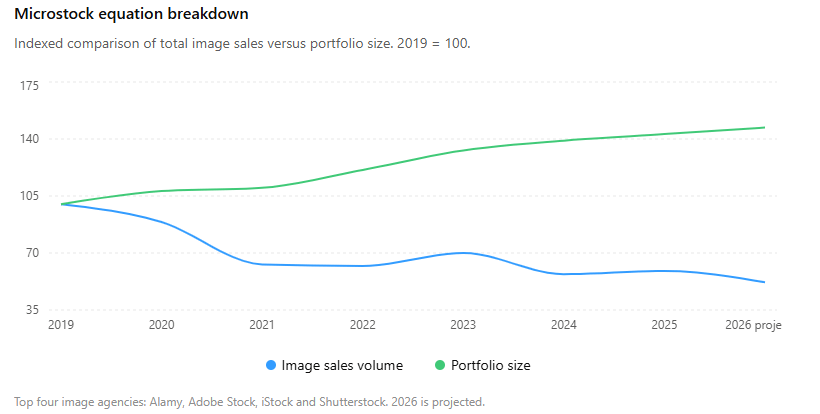
However, since 2019 my annual image sales volume has collapsed by roughly 48% to the projected 2026 result. It’s crazy to think that I was selling 10,000 images a year in 2019.
The double whammy is that average earnings have also fallen in my case, 8.8% to the projected 2026 result.
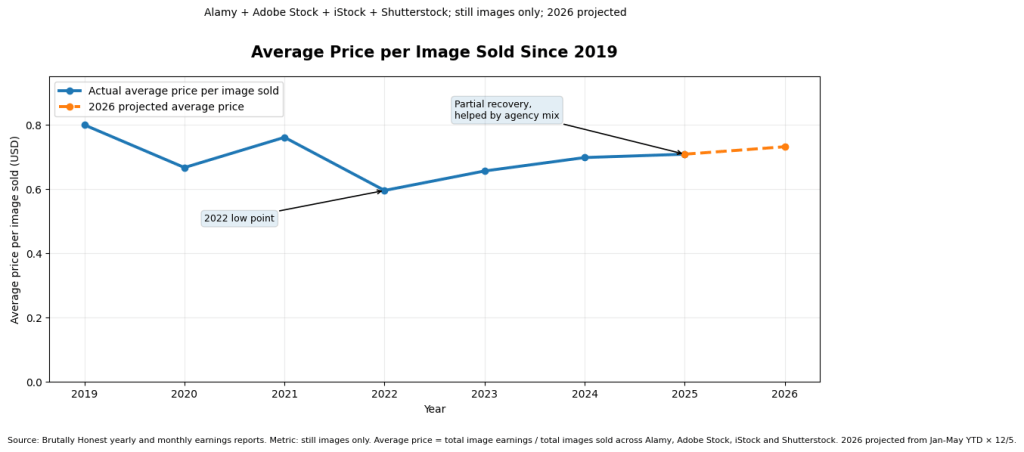
This business (or any business) does not exist in a vacuum. Inflation matters and over the past seven years, cumulative inflation in Western Europe has been around 30%. Once that is factored in, the real-world drop in average earnings per image sold is closer to 29%.
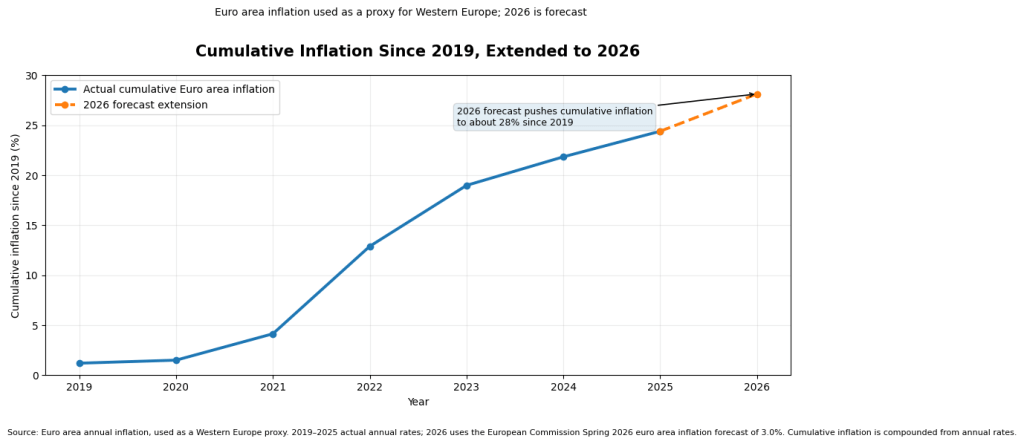
So, it’s those three numbers that matter the most.
Let’s talk about my portfolio size
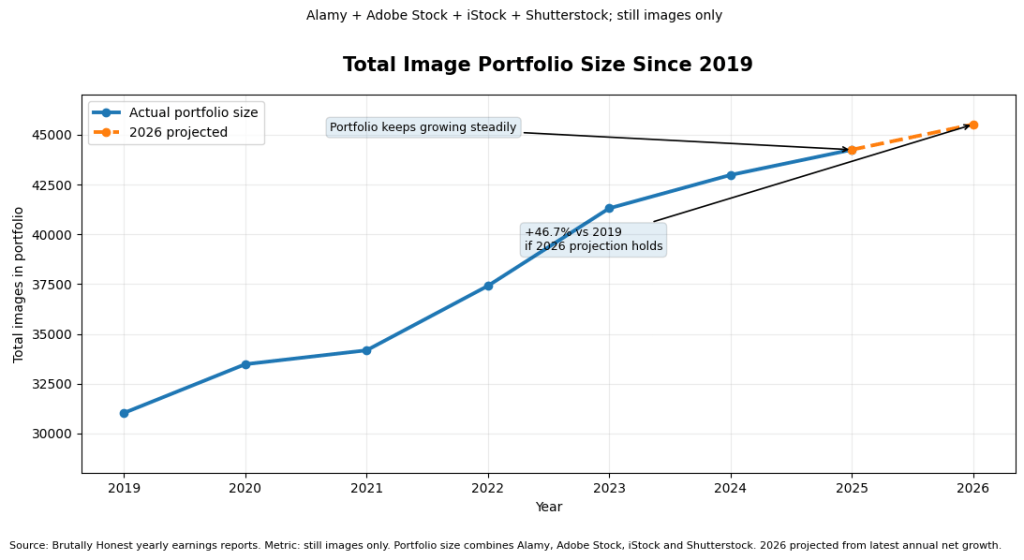
My combined image portfolio across the top four agencies now stands at just over 45,000 images and has grown steadily since 2019. That sounds positive until you compare it with the sales trend.
Although the portfolio is much larger and higher quality, sales are lower.
So I asked ChatGPT a depressing question:
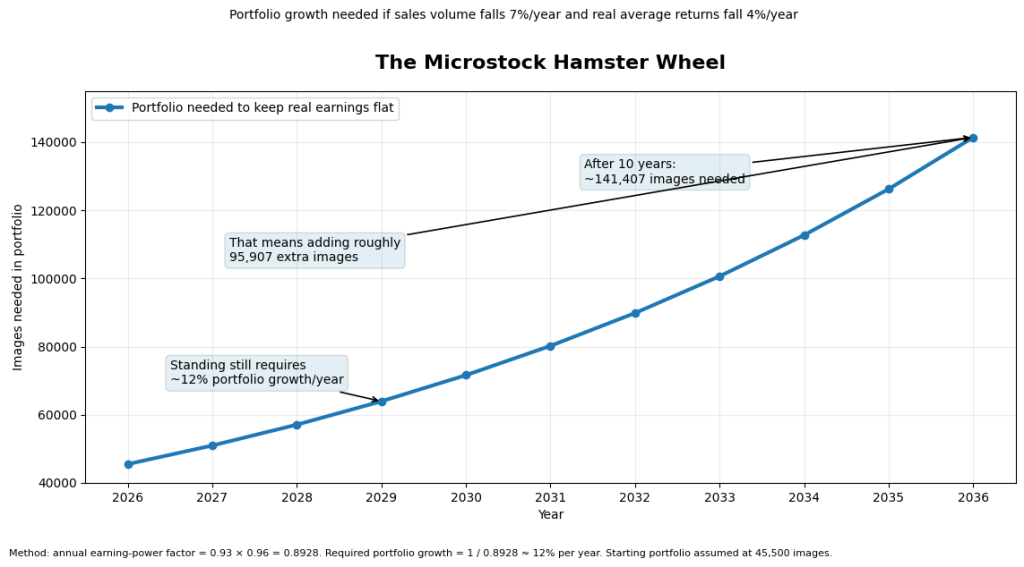
Suppose I stop uploading today and my sales volume is falling by roughly 7% a year, and my real-world average return per image is falling by roughly 4% a year, how much would my portfolio need to grow over the next 10 years just to keep earning the same?
The answer was not encouraging.
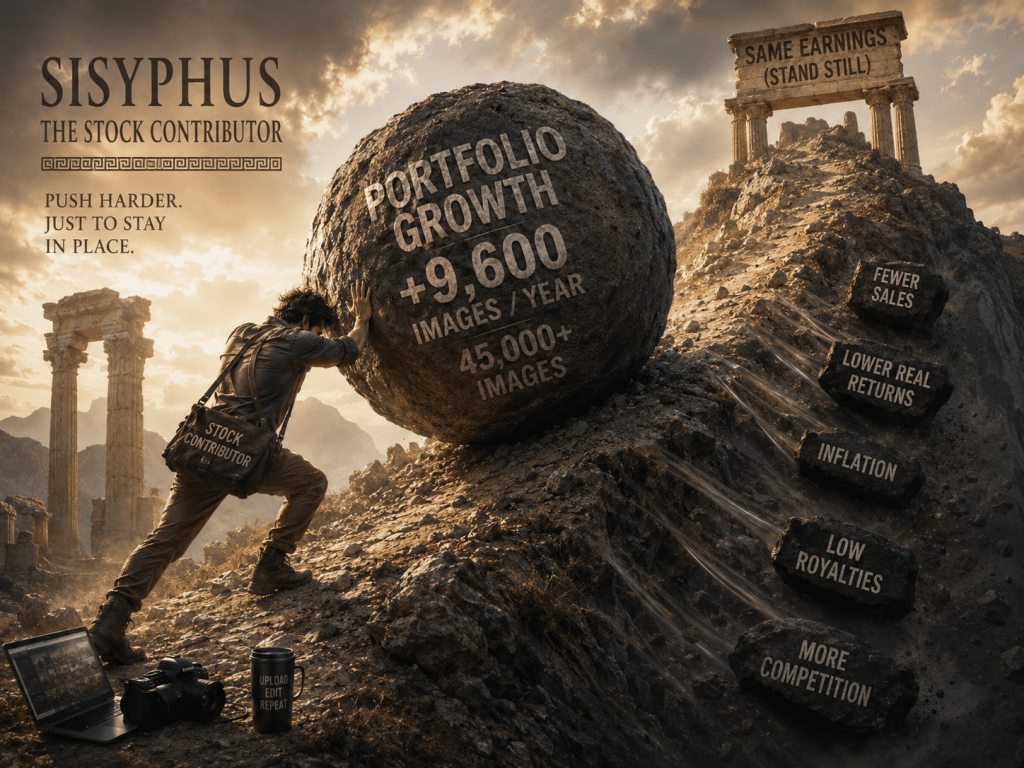
To keep earning the same at those agencies, based on those trends, I would need to grow the portfolio by roughly 12% per year, which in practical terms, that means adding close to 9,600 extra images per year. Just not going to happen.
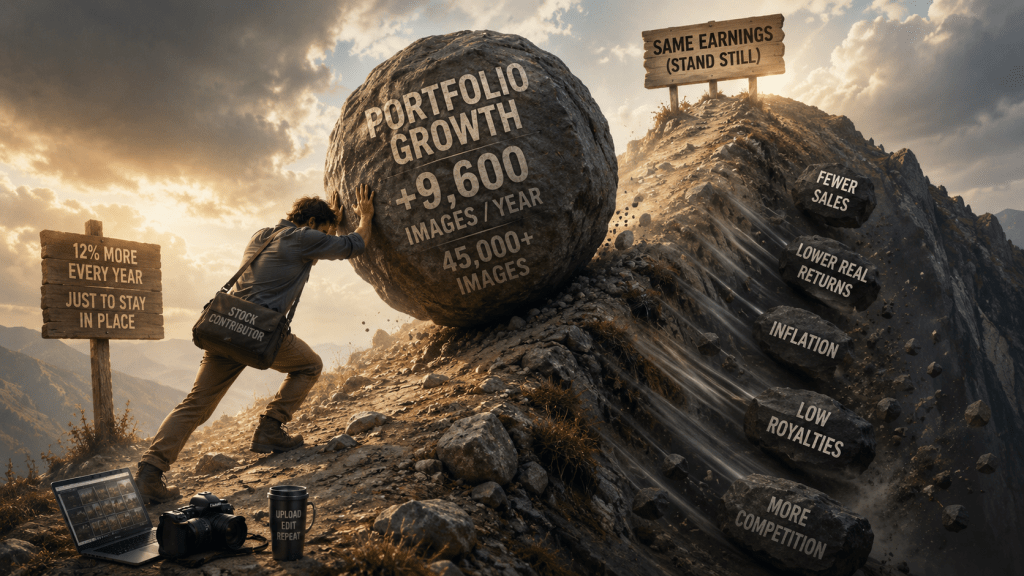
Yeah, that reminds me of that Greek myth starring Sisyphus.
What about clips?
The picture for clips is not much better.
Since I started reporting earnings in early 2019, average returns per clip have also fallen hard. That is especially frustrating because video is much harder to produce than still images: more planning, more travel, more editing, more storage, and in my case, plenty of drone flying.
The likely culprit is the expansion of subscription models into footage. I remember when 4K clips still felt premium and could generate proper royalties.
Today, clips are increasingly treated like just another subscription asset: more supply, lower prices, and buyers expecting more for less. The Netflix / Spotify model adapted to this business.
So even though my footage portfolio has grown substantially, the economics have not followed. Footage was supposed to be an escape from the low-value image market. Instead, it is being dragged into the same race to the bottom, or even worse.
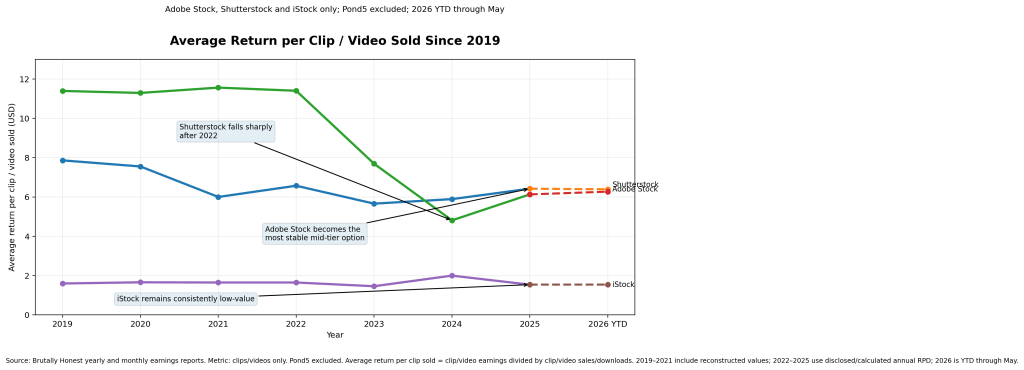
I’ll discuss the steep fall from Pond5 separately.
The worst offender: Shutterstock
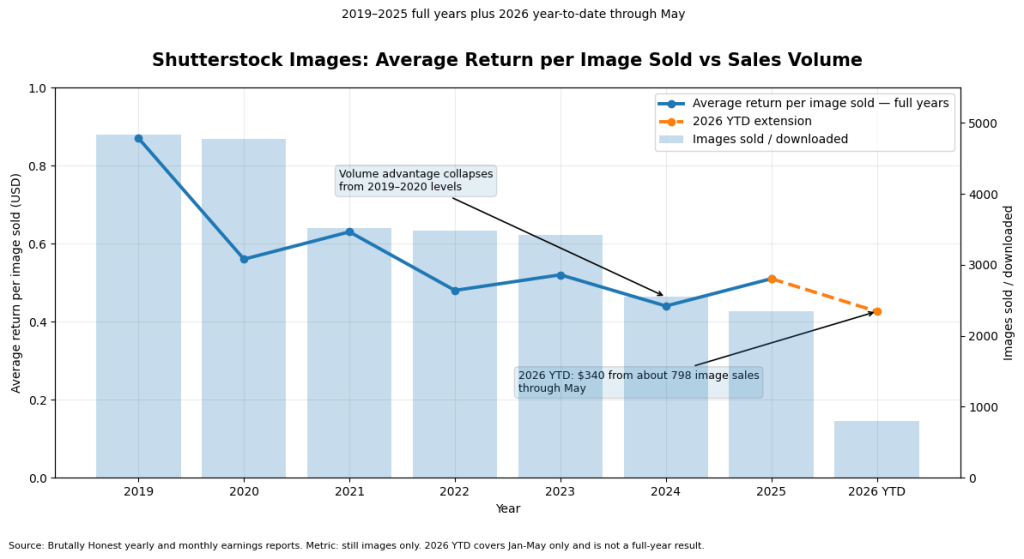
Shutterstock is the most painful example because it used to be the volume king and by far my best-earner for many years. In fact I’ve been uploading to them since 2012.
However, my Shutterstock current earnings are now a shadow of their former selves. The agency still sells but the old economic logic has broken down with relatively tiny subscription volumes. The worst damage occurring from 2020.
Clips
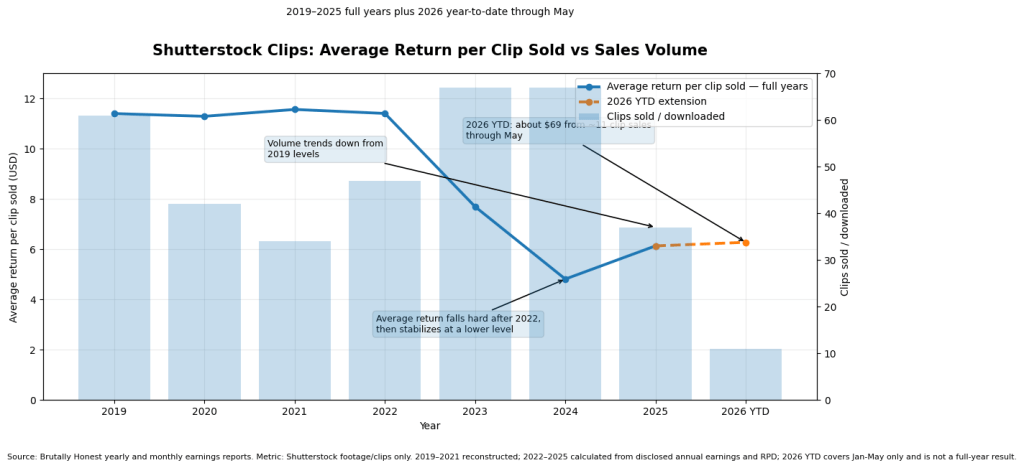
On the clips side, the picture is also ugly. Volumes have not completely disappeared (I did begin to upload a lot more clips) but average prices have fallen hard since 2022 and not recovered.
Always a low earner: iStock
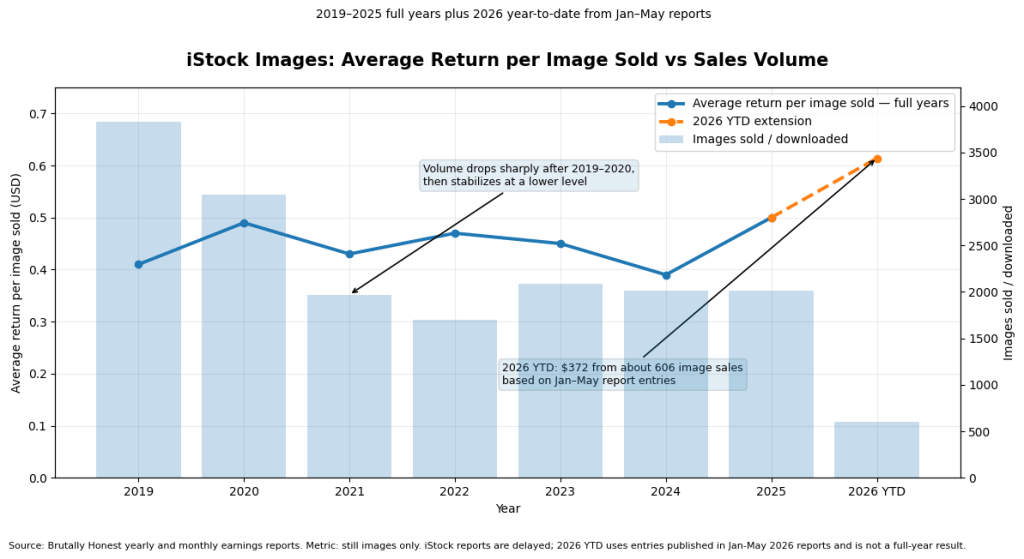
iStock has always been relatively stable for me, but in a not-very-exciting way. Probably the most frustrating agency for me since no matter how many new assets I upload, iStock never gives me the feeling that I am building something with real upside. Average prices are now similar to Shutterstock and how convenient since they’re merging.
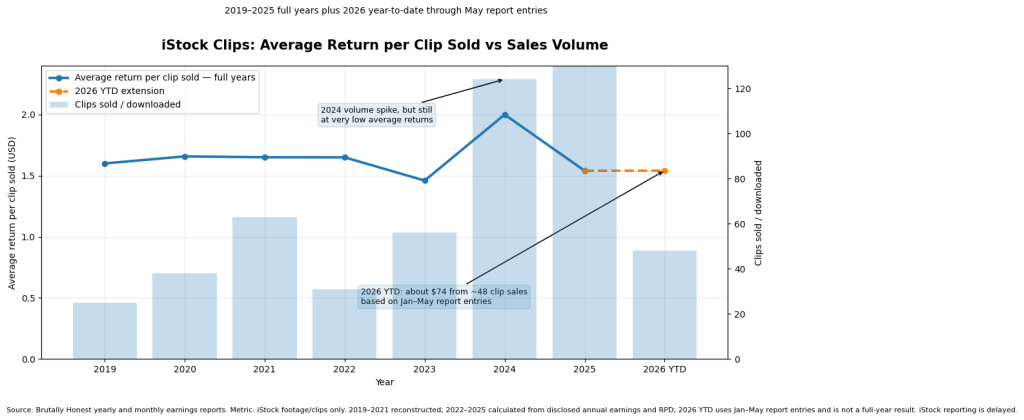
Clips
For clips, volume has improved somewhat (with increased uploads), but the average return per clip sold is still extremely low.
Alamy: High Prices Cannot Fully Offset Low Volumes
Alamy is different from the classic microstock agencies since they don’t operate on the subscription model. They’re also focused more on editorial / newsworthy types of content.
On average, it pays considerably more per image sold than Shutterstock, Adobe Stock or iStock. But Alamy has its own problem: low volumes (around 10x less than Shutterstock).
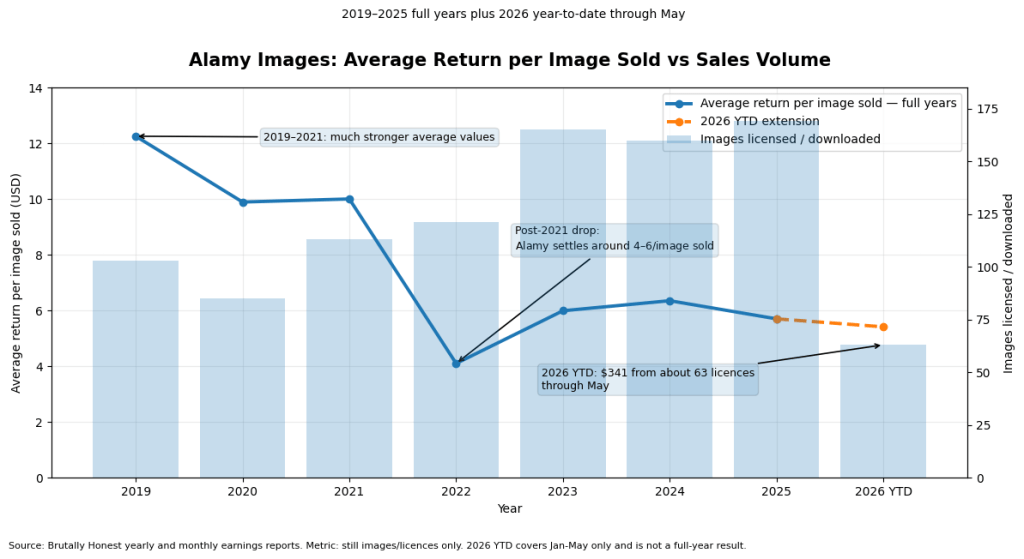
The royalty cut from 50% to 40% in 2022 hurt contributors and clearly visible in the chart. High prices are useful, but only if enough sales arrive.
Adobe Stock: The Healthiest of the Mainstream Agencies
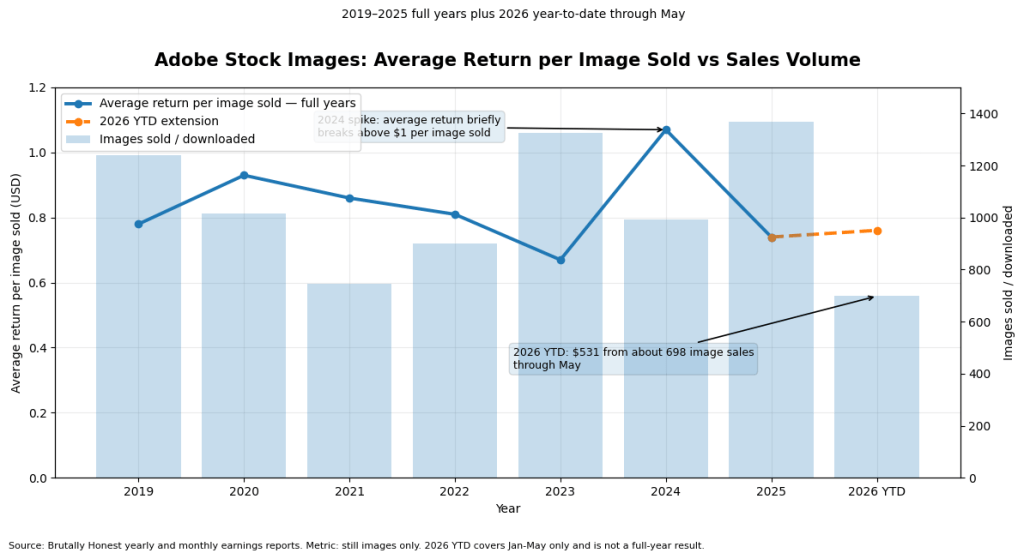
It’s not all doom and gloom as Adobe Stock tells a more positive story.
For images, Adobe has been much more resilient than Shutterstock and iStock with average prices twice their average.
Clips
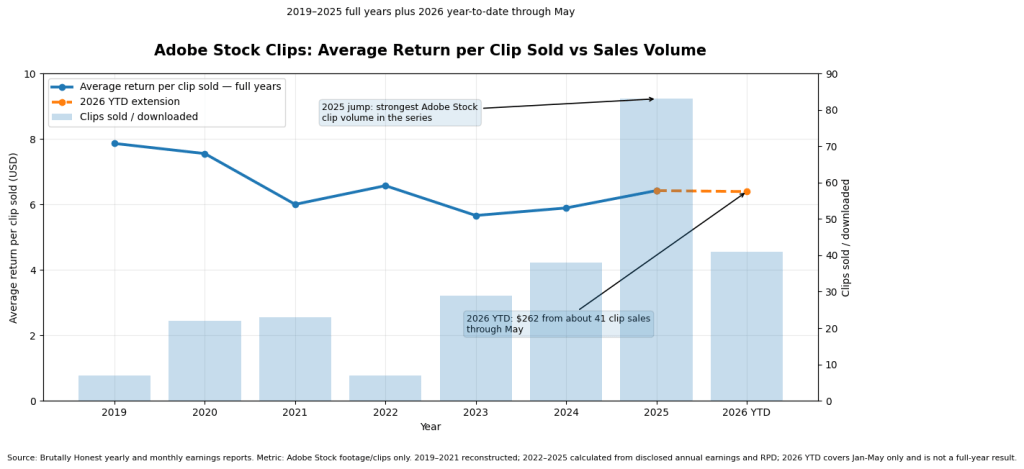
For clips, the story is even more encouraging as they’ve shown much better signs of life than their competitors.
$5 Giveaways
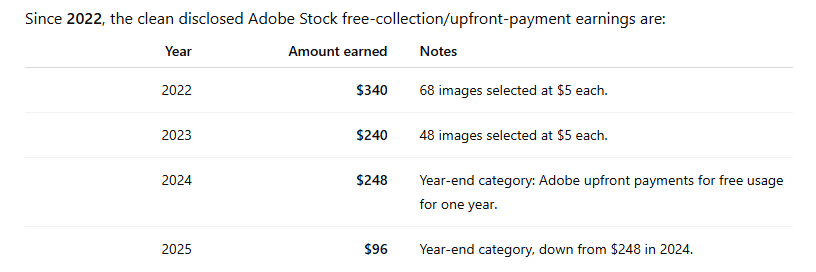
There is also the Adobe Stock free-collection upfront-payment scheme. Historically, Adobe has paid contributors upfront, for example, $5 per selected image and later $8 per selected clip, in exchange for allowing selected files to be used in the free collection for a year.
I have participated in this because, realistically, the money can be useful. Since 2022, these payments have added up to around $924.
Pond5 Disappoints
To be fair, Pond5 still has respectable average returns per clip sold, although this has also crashed. A good Pond5 sale can still look much better than many microstock video sales. The problem is volume and consistency.
No idea what is going on behind the scenes but since the Shutterstock acquisition, Pond5 has become increasingly difficult to trust as a dependable footage outlet.
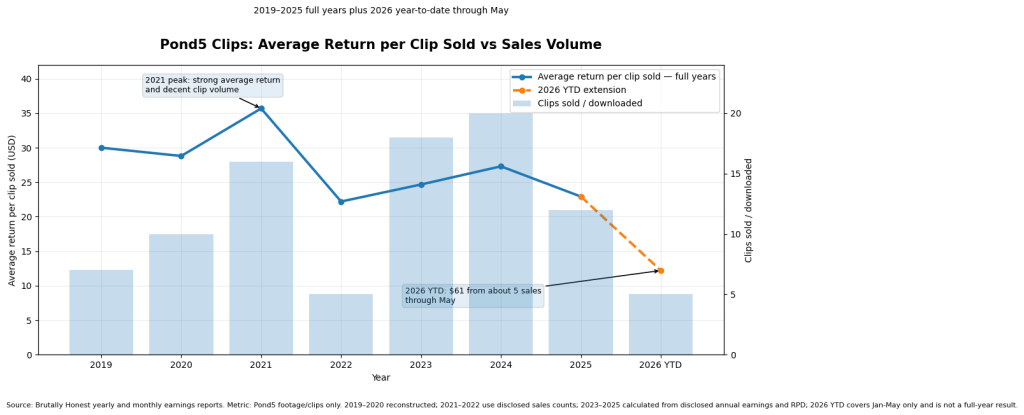
The situation seems critical as my 2026 year-to-date Pond5 result is only about $61 from five sales through May.
AI Training and Dataset Payments: A Small Increase, But Not Good News
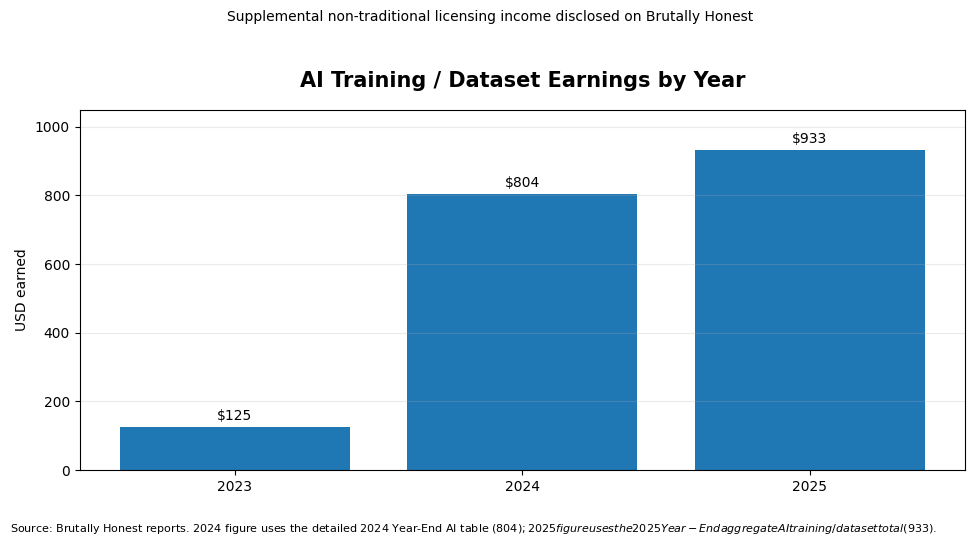
There is one more category that now needs to be included in any honest earnings analysis: AI training and dataset payments. At first glance, this looks like a rare bright spot.
In 2023, I earned only $125 from AI-related payments. In 2024, that increased sharply to $804, helped by Adobe Stock AI/Firefly payments, Pond5 dataset earnings, Shutterstock’s Contributor Fund, and smaller dataset payments elsewhere. In 2025, the total increased again to $933.
So yes, technically, this is extra money. But I would be very careful before treating it as good news. I see it more like an early redundancy payment.
Passive Income? Sure, I Still Welcome It
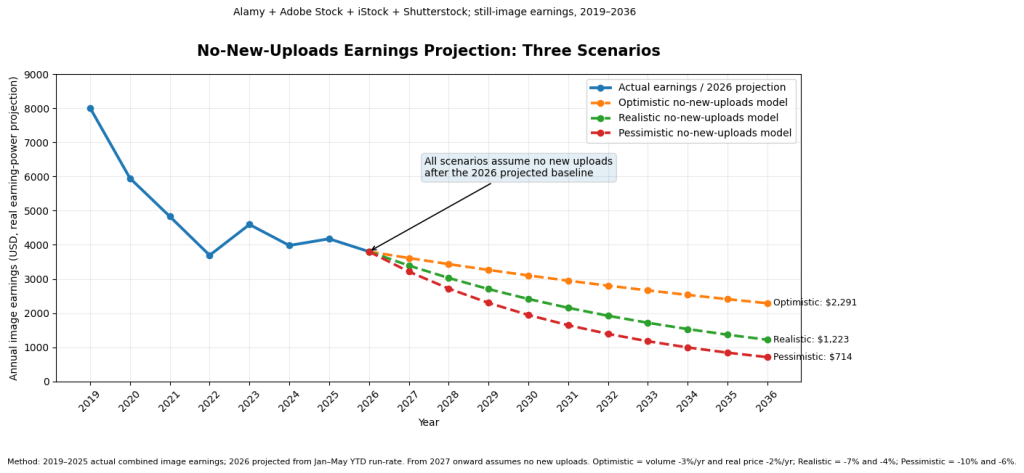
One thing I have always admired about stock photography is the passive-income element. It’s not immediate but once you pretty much completely stop uploading it becomes evident. That part of the business still has value.
I asked ChatGPT to project my earnings from the top four image agencies over the next 10 years under three no-new-upload scenarios: optimistic, realistic and pessimistic. Even the optimistic model was not pretty although enough to upgrade some gear and travel.
The Real Conclusion: Not All Agencies Deserve Your Best Work
This is obvious to me now, and in fairness I have been sending my best work elsewhere for years, with mixed results. Arcangel comes to mind which I won’t discuss here.
Amazing Aerial
However, one agency that I will discuss is Amazing Aerial who I’ve been uploading to aggressively for the past six months, including recent Rio clips/photos of the World Cup vibe.
Amazing Aerial has been transitioning to a new platform, so earnings reports have been delayed. But I finally got a glimpse of my March, April and May results.
No, I am not yet earning like Hugo, who reportedly made over $1,800 in two months from around 4,000 assets. Well done, Hugo!
But I currently have just over 1,175 assets to date there, so the comparison is not exactly equal. Plus I have to admit that he’s shooting much more closer to what the market needs in terms of modern infrastructure.
Nevertheless, after only a few months I earned $76 in March/April.
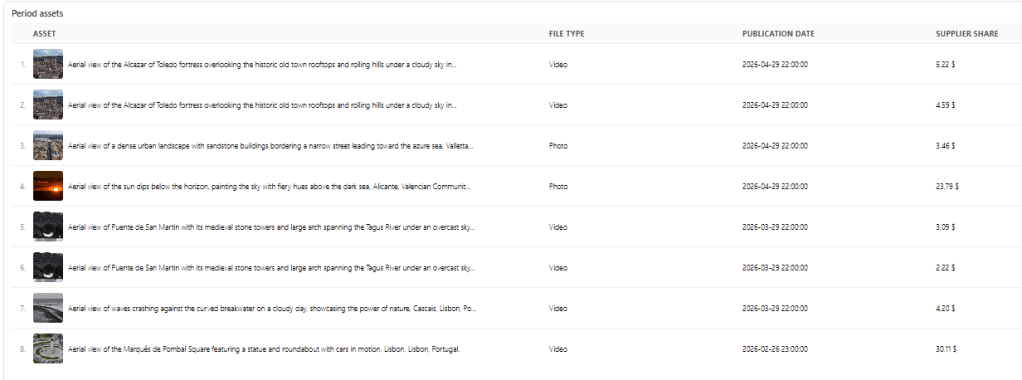

I’ve been informed that I’ve earned $198 in May, although I am still waiting to see the exact individual sales details. Will report on exact earnings at the end of the month.
Get in Touch if You Want to Contribute to Amazing Aerial
I am an Ambassador for Amazing Aerial and can help contributors get started there.
That said, I am not aggressively pushing the agency as some magical solution. I want to prove first, including to myself, that I can earn there consistently month after month. Or you may take Hugo as an example.
But if you have strong aerial work and want to give it a try, get in touch. I can take a look at your portfolio and advise on the next steps.
Three Brutally Honest Takeaways
1. The old microstock equation is broken
This shows the core contradiction: portfolio size is rising, but image sales are falling. Both are indexed to 2019 = 100 so the divergence is easier to see.
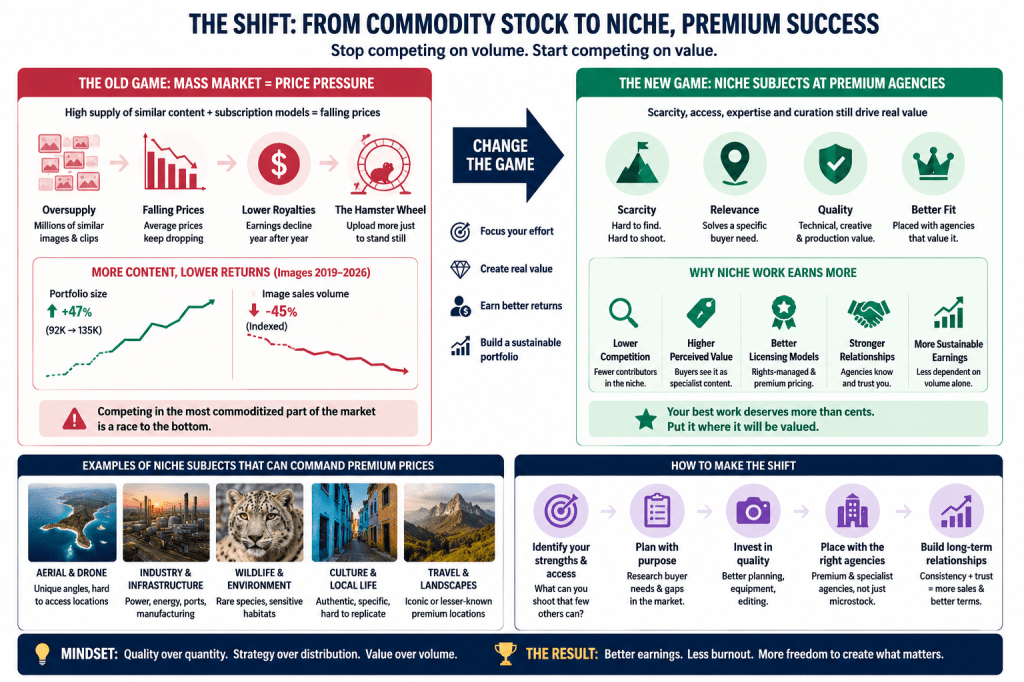
2. The strategy: move higher up the value chain
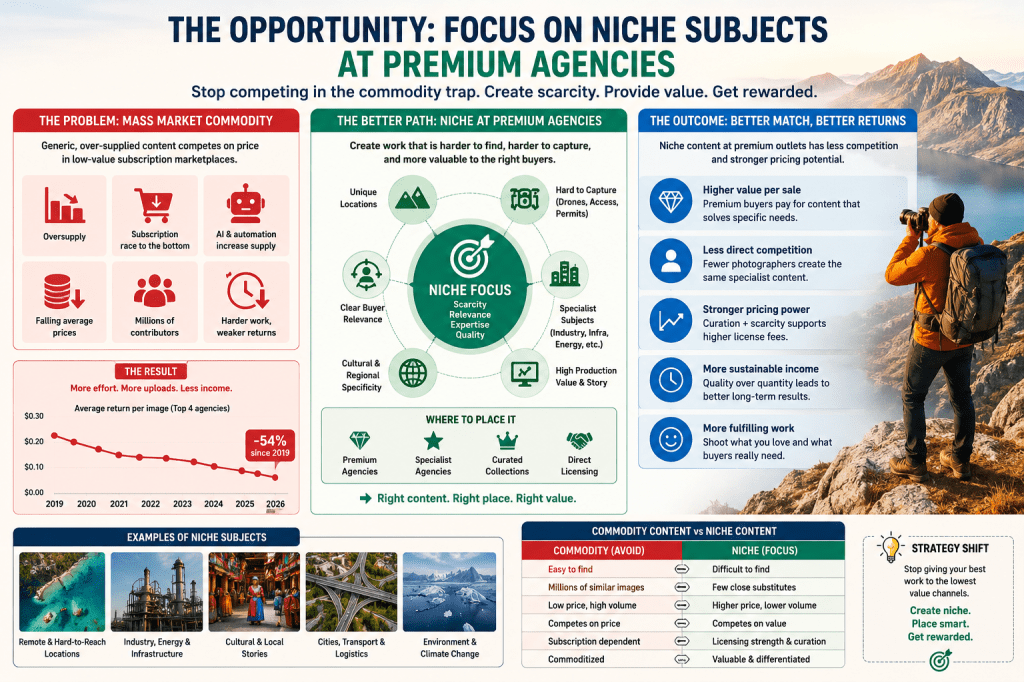
This turns the conclusion into a simple strategic ladder: the best work should move away from low-value mass distribution and toward premium or specialist outlets. Even if volumes are lower it should be make up with higher average prices or at worst at least you’re not selling your soul to those devils.
3. Shoot niche subjects that sell, Hugo-style
This is something that I’ve begun to focus more and more on especially with the drone. For instance, instead of shooting what is pretty but with low commercial value (such as landscapes), focusing on shooting “ugly” infrastructure at a distance. This includes, solar panels, AI data centres, transport hubs, highways, etc.
Hope you’ve enjoyed this blog post and found it useful for your own business. I’ll be back at the end of the month with my earnings report, as usual.

About Alex
I’m Alex, eccentric, based in Lisbon, and on a mission to explore every corner of the globe while capturing stock images and footage along the way.
For the past 12 years, I’ve been grinding as a travel photographer/videographer and freelance writer. Along the way I’ve also written The Brutally Honest Guide to Microstock Photography, a book packed with war stories and practical tips for anyone crazy enough to enter this business and more recently, The Brutally Honest Guide to Drone Laws in Europe.





 Alexandre Rotenberg's Brutally Honest Guide to Stock Photography & Footage
Leave a comment