

Getty Images, the most recognisable name in stock photography, is now facing something considerably more serious than declining contributor royalties, AI disruption or another round of cost-cutting.
Ultimately, what does this mean for contributors?
Getty has a very real debt problem.

There are two main factors at play to reach this critical juncture.
The AI Problem
Generative AI has already weakened demand for generic commercial imagery by allowing customers to create increasingly tailored visuals themselves, often in seconds and at very low cost.
That matters because much of traditional microstock was built around exactly this type of content: business meetings, lifestyle concepts, backgrounds, food, technology, travel concepts and other easily reproducible commercial themes with increasing accuracy.
AI doesn’t need to replace photography completely to damage that market. It only needs to take away enough routine licensing demand to put additional pressure on prices, subscription revenues and agency margins.
And this is a structural problem facing the entire industry, not just Getty.

The Failed Shutterstock Deal
The timing of Getty’s current problems is particularly striking because, only months ago, the company was preparing for a very different future.
Its proposed merger with Shutterstock was supposed to create a much larger visual-content powerhouse, combining two of the biggest names in stock photography and giving the enlarged company greater scale at a time when the industry is facing increasing pressure from generative AI.
Getty lost the opportunity to gain the additional scale, customer base and cost efficiencies that the merger was expected to provide. Almost immediately afterwards, the company hired Guggenheim Securities to advise on “strategic financing alternatives and balance sheet management initiatives.”
Latest developments
On September 1, Getty chose not to make scheduled interest payments on two sets of senior unsecured notes and entered the 30-day grace periods allowed under those agreements.
Getty said it had enough cash to make the payments, but elected not to while evaluating “strategic financing alternatives and balance sheet management initiatives.”
From Grace Period to Possible Chapter 11
Bloomberg has reported that Getty is discussing fresh financing with lenders, potentially including financing normally associated with Chapter 11 restructuring.
Discussions reportedly also include the possibility of lenders taking control of the company.
Getty has not filed for Chapter 11, but it is clearly now a serious possibility.
What Would Chapter 11 Mean?
Chapter 11 does not normally mean the business immediately shuts down.
It usually allows a company to continue operating while restructuring its debts.
Getty still has major value in its brand, archives, customers and contributor network, so I would expect Getty Images and iStock to continue licensing content even during a restructuring.
What About Contributor Royalties?
The key issue would be money already owed to contributors.
Amounts owed before a possible bankruptcy filing could potentially become claims in the restructuring process, while payments generated afterwards may receive different treatment.
Nobody can say exactly how contributors would be treated until an actual filing appears. At the moment we can only speculate how this will all pan out, although it’s certainly looking quite bleak.

Contributors, including myself, are actually reporting higher sales volumes?!
Turns out there’s a silver lining in every cloud. Since stock purchasers are also following the news, many have decided to take full advantage of their subscription packages and start downloading.
In September, I’m reporting double my July volumes.
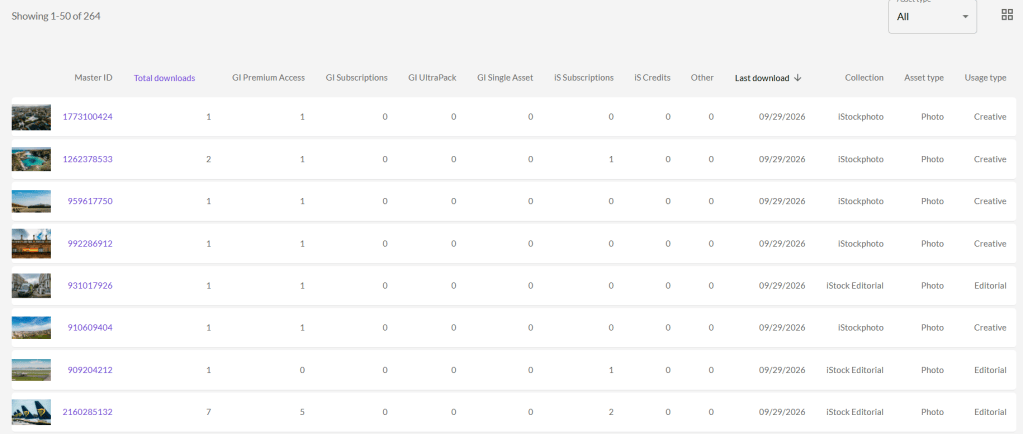
Although I wouldn’t be surprised if in October I/we receive half the usual volumes, so a short celebration is out of order.
Could Getty Cut Royalties even Further?
Possibly, since a restructured Getty could emerge with new owners, tighter cost controls and stronger pressure to improve margins.
Getty/iStock already pays just 15% on much non-exclusive content. How much lower can it really go?
Should Contributors Stop Uploading?
For me, not much changes as I’m already barely uploading to iStock, Shutterstock/Pond5 and Alamy, and I’m focusing more on building my portfolio at Amazing Aerial.
If you already have content earning money at Getty/iStock, I wouldn’t panic and delete it. But why would you enthusiastically upload fresh work there right now?
Until Getty’s financial position becomes clearer, it’s best to invest your new content elsewhere.
Fast-moving development
Keep up to date with what is happening on the following blog post
Getty Images and Chapter 11: What It Means for Contributors — PixTagger
As well as discussion on the MSG Forum thread.

About Alex
I’m Alex, eccentric, based in Lisbon, and on a mission to explore every corner of the globe while capturing stock images and footage along the way.
For the past 12 years, I’ve been grinding as a travel photographer/videographer and freelance writer. Along the way I’ve also written The Brutally Honest Guide to Microstock Photography, a book packed with war stories and practical tips for anyone crazy enough to enter this business and more recently, The Brutally Honest Guide to Drone Laws in Europe.




Leave a comment