
Welcome to another guest-post by MEPS, specialists in motor drones. See here for the first post – How to Build a FPV Drone for Beginners. In this article we’ll go over some flying FPV drone practice skills and drills that should help you to competently pilot a Brushless Drone*.
*Brushless motors have no mechanical commutation but rather rely onelectrical signals for their commutation. The speed of the motor’s spin is controlled by a controller that sends periodic pulses of current to the motor’s electromagnets
How difficult is it for beginners to pilot an FPV drone?
You may have the impression that flying a FPV drone is easy because it seems like everyone is getting into the hobby. All drone enthusiasts have to start somewhere, and almost all of them struggle at first to get used to the controls.
That’s why we recommend to first purchase an FPV simulator which is like a video-game to get used to the controls. FPV simulators are the best and most affordable way to hone your FPV flying abilities.
Controlling a FPV drone involves being in charge of the technology at high speeds a fairly delicate technology that may quickly crash and break when a tiny errors are made.
What should you know before flying a FPV drone?
Drones are not toys and can be dangerous. To guarantee a safe flight, let us outline some basic safety measures:
- Reduce the throttle to zero before crashing into anything to avoid damaging your drone, hurting someone, or hurting yourself.
- Before doing any repairs on the drone yourself, remove the battery. You may find it difficult to fly in the future if you inadvertently turn it on and the propellers begin to spin.
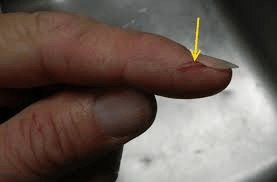
- When the propellers are in motion, keep your fingertips away from them as they are quite sharp.
Using the radio controller
An FPV drone is controlled by a radio transmitter (TX), which is comparable to a game console.
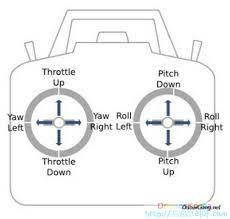
Learning the radio controller is the first step to flying an FPV drone. The FPV drone’s movement is managed by two sticks on the transmitter:
- Throttle: The FPV drone may climb or descend by using the throttle.
- Yaw: Yaw causes the FPV drone to rotate either clockwise or counterclockwise.
- Roll: The drone tilts left or right.
- Pitch: The quadcopter’s pitch can tilt it forward or backward.
Flying in Line Of Sight (LOS)
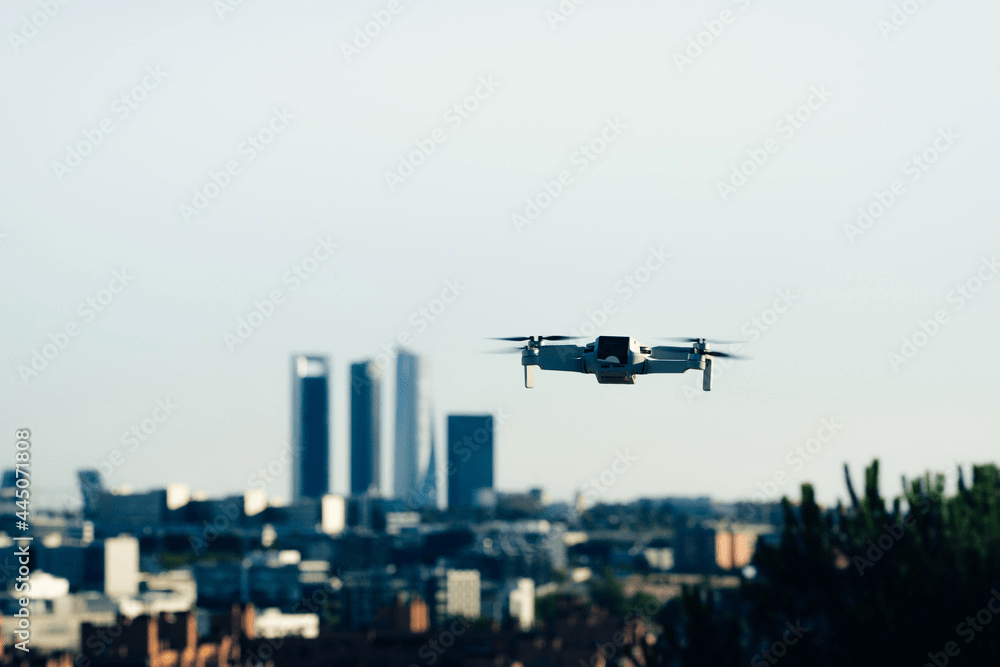
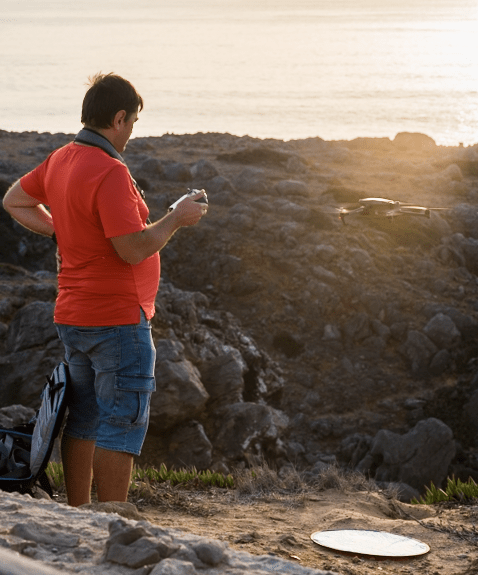
When a drone is flying in LOS, you are operating it by looking straight at it rather than through FPV goggles or a display. It’s best to have some LOS flying experience before diving right into FPV. This is helpful since it allows you to securely land and control your drone even if you lose video signal.
Keep to simple moves at first
It’s not necessary to acquire complex maneuvers; the most important thing is to ensure that you can stabilize the quad and maneuver it throughout the field without it becoming lost. It’s crucial that you face forward while standing behind the quad when beginning your flight. This makes it simpler and more straightforward because your quad movements will react to your transmitter sticks in the same direction.
Almost immediately, you should raise your quad to a height of around one meter off the ground. Your quad may become unstable due to air disturbance (ground effect/prop wash) if it is too close to the ground. Make an effort to hover and maintain the same position and height. It’s challenging since you have to simultaneously manage the throttle, pitch, and roll.
Safety Considerations
Don’t fly your FPV drone too close to people and aim to practice in an open field, and make sure you have enough room to recover from mistakes. To aid with distance perception and spatial awareness, use trees or poles as points of reference.
- Practice landings, yaw turns, speed and altitude control, and forward flying.
- Additional turn practice and adjusting your route after turns
- practicing combined yaw, roll, and throttle control
- The capacity to execute precise, acute maneuvers, which helps you to prevent collisions. Making sharp turns is another efficient method of stopping.
- Practice using your swift flight speed and deft stick handling.
How to improve FPV flying skills for Optimizing Your Time
All hobbies require practice, but drone racing is particularly important because control and response times are crucial. Here, we recommend MEPS FPV Motor 2207, designed for the harsh environment of professional racing and racers’ extreme demand for a sense of control. Additionally, it is important to improve FPV flying skills for Optimizing Your Time.
How to Determine What to Practice for FPV flying
It is important to take some time to sit down and think back on an FPV flying day. We can assess what about FPV flying I’m happy with (for the time being, as there’s always space to improve) and what needs better by watching the videos recorded. Whenever you re-watch the videos, you frequently evaluate different parts of the video, like:
- “How many laps or flights did I need to get the hang of the track?”
- “How quickly did I create and refine a number of racing lines?”
- “What were the primary course components that were consuming my time?”
- “How steady was my pace after I got the hang of the track?”
- “What went wrong, and how can I prevent it from happening again?”
Track Element Drills
Track element exercises are a basic form of FPV flying training that can help you get better at certain track aspects. We suggest putting up some gates (or locating appropriate tree branches) and spending a few packs honing that particular track piece. Always practice reversing your direction when practicing an element. This stops a turning preference from developing.
To encourage oneself to approach your FPV practice course element from both directions, we also suggest putting a flag (or tree) before and after it. Setting an exit direction in advance also helps to connect course components, which is helpful for flying FPV on large courses.
Full Track FPV Practice
Practice for specific track elements differs slightly from that for whole track FPV. Your subconscious must be able to swiftly and efficiently connect the course elements once it has created its own model for handling them. Flying FPV drone with full track FPV enables this development. Your brain will get more adept at optimizing course element linkage the more it practices. Once you have a solid feel for the course and are maintaining a steady pace, we suggest circling the course in reverse to make the most of your time there.
Using a Race Tracker
Depending on the aspect of your FPV flying you want to work on, using a race tracker can help or hinder your practice of a whole track. A race tracker’s benefit is that it can put pressure on you by providing you with frequent timing updates, which helps pilots learn to remain composed under duress. Additionally, timing gives you a race pace update, which makes it easy to analyze the previous lap and determine whether or not you used the right racing line.
Conclusion
Flying an FPV for the first time can be a daunting experience but there are plenty of resources out there to aid you on to hone your skills. Even before you get started you can practice on a simulator and slowly build up your confidence flying in an open space with safety precautions in place.
About MEPS
Being a professional supplier of all-around power systems (Including FPV drone / fixed-wing drone / multi-rotor / robots power system products), MEPS® is committed to providing you with high-standard products and user experience.
MEPS®, relying on talented and scientific research materials from well-known domestic power research institutions and key universities, has made breakthrough achievements in the research and development of efficient, lightweight, and reliable power systems. MEPS® innovatively adopts the third generation of “aviation aluminum” represented by aluminum-lithium alloy as the raw material, which effectively improves heat transfer, and at the same time, enhances the endurance of the motor. Tens of thousands of drop impact tests lead us to the trust of users! Our products are widely entrusted in various scientific and technological fields such as unmanned aerial vehicles, robots, automatic driving, and aerospace.
Our team is a group of professional and passionate engineers, designers, FPV enthusiasts, product testers, and marketing personnel. All materials, parts, and processes are under strict control to ensure that each product meets the highest standards of quality and functionality.
MEPS® is an integration of the R&D team, production team, and sales team, providing highly competitive products to meet the requirements of different customers in multiple scenarios.
We are MEPS® We are here to break your imagination!
 Alexandre Rotenberg's Brutally Honest Guide to Stock Photography & Footage
Very valuable information, thank you! Although I will have to put it aside for now, because I am still perfecting my flight with my mini drone 😁😁
LikeLike