
Hope you enjoyed my first-ever slightly awkward YouTube Earnings report. Here’s a recap!
It’s exactly one week to go before I embark on a 19-night transatlantic cruise from Barcelona to Rio where I’ll be sure to capture many sights and probably gain 10kg.

In the meantime, as I’m not shooting so much these days as I prepare for my voyage I’ve decided to crunch some numbers to see how I’ve done over the years and whether I can spot some earnings trends within my port. Let’s get started (Warning: stats-heavy post but will try to make math fun)!
This post is sponsored by PhotoTag.Ai
Check out my detailed brutally honest review of PhotoTag.ai, a software that “Automatically generate image tags, titles, and descriptions using cutting-edge AI” and obtain a 30% discount for new members within the first three months.

This post is also inspired by Jamo Image’s historical earnings analysis
Jamo Images, a Finnish photographer, has started reporting on his monthly earnings on his blog – here’s a link to his Sept and Oct results. I’ve been inspired by his very pretty historical trendline since January 2017! As well as overall results on a relatively small portfolio.

So, my curiosity got the best of me and I wanted to see if my trendline is similarly sexy for roughly the same time period.
Detailed Earnings Reports since Feb 2019
To be honest, as always, when I first started contemplating reporting my earnings back in early-2019 I thought I wasn’t earning enough to be any sort of “authority” in this business like Steve Heap, but I would once I eventually start to earn considerably more. Little did I know/forecast that my earnings would have peaked only a few months later! Four years later, it feels like a struggle to earn the same despite constant uploads, which is extremely frustrating!
Nevertheless, I’m also glad that I started publishing my earnings because it motivated me to try to earn more! Imagine if I had slacked off then I would have seen an even larger drop.
So, anyway, let’s get onto the numbers.
Key Metrics – November 2023
- Roughly 16,000 images spread around 12 agencies (same image counts as 1, also below)
- Roughly, 2,500 clips spread around 5 agencies
- Roughly 500 Print on Demand images at 2 agencies (Photo4me and Fine Art America)

For the purposes of this discussion I won’t include Arcangel images since it’s like comparing apples and pears.
Results since 2014 (images)
Even though I started to record more seriously since Feb 2019, I’m able to pull some stats using Microstockr (great tool by the way) since I began my journey in early-2013. Didn’t have many sales in 2013 so for the purposes of this post will show results from 2014, starting with stills:

Lots of information from the above so will break it down here:
- Total downloads peaked in 2019 at just over 10,000/year and have steadily dropped by some 30% towards the forecasted amount of 7,000 for 2023. This is concerning particularly as my port is growing at 10% a year.
- Return per download has been steady since 2014 at an average of 69cents/download, peaking in 2018 at 77cents/download. This is at least encouraging since I thought it would have dropped by more than that after Shutterstock’s mid-2020 “exciting news” on the new tier system that resets every January.
How has Alamy performed over the years?
My earnings at Alamy are all over the place and I’ve wanted to see if my average RPD has also dropped at Alamy over the years (contributor since 2016):
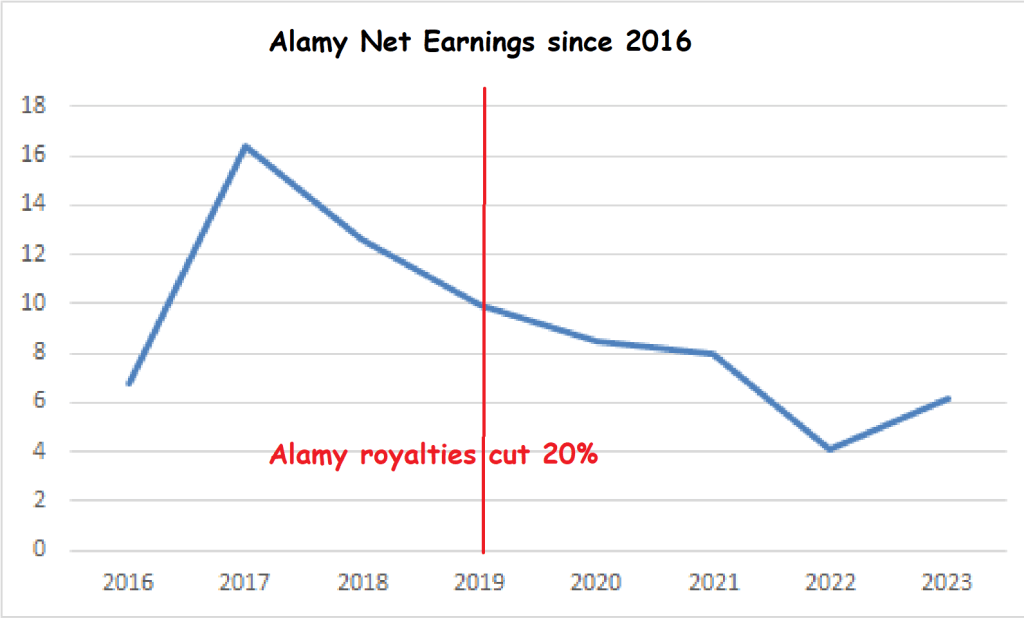
And as suspected, there has been quite a drastic drop in RPD, by far the most out of all the agencies reported. From the peak 2017 at 2023 it has dropped by a whopping 62%, which is partly unsurprising since Alamy reduced contributor earnings by 20% at the start of 2019 (indicated by the red line above).
One reason for such huge drops in average download prices at Alamy are those tiny microstock sales, particularly from China, at the end of every month. Those never existed prior to 2022.

Moving onto footage:

Lots of information from the above so will break it down here:
- Total downloads/sales are increasing year-on-year quite rapidly, particularly since 2022 when I began uploading drone content. It’s nice to report that 2023 will easily be a record year with a forecast of 180 sales which is double the 2022 result. This is good news and perhaps will be able to increase that in 2024 as I keep on shooting more drone footage.
- Even though I started footage in 2018 (a little late to the game) and right away I began to have quite high-value sales with an average of $17.30/download peaking in 2019, just like images. However, average download prices have absolutely crashed to the current 2023 average of just $6.84/download…a whopping 60% drop! I needed to dig deeper…

Digging deeper as to why there was such a crash in footage RPD
I looked at my top-3 agencies where I license stock footage (didn’t include Adobe Stock as they don’t accept editorials so wouldn’t be a fair comparison).
Starting with Shutterstock:

Let’s now look at Pond5

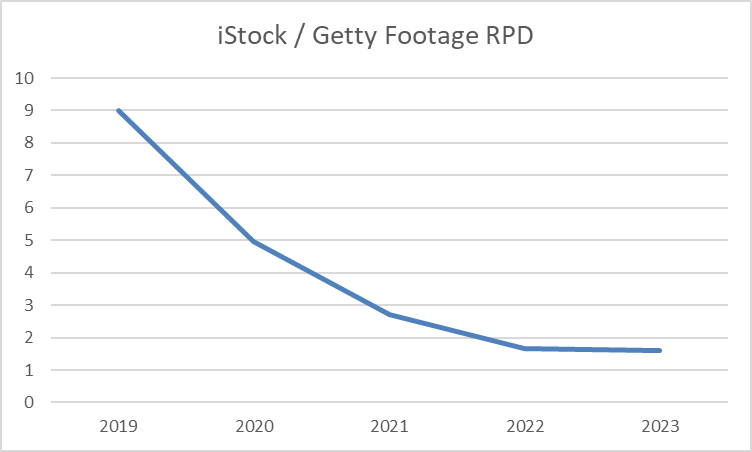
Lastly, onto iStock / Getty:
Conclusion:
The largest drop, by far was at iStock/Getty, which are really pushing prices downwards. If you don’t upload footage to them, I honestly don’t blame you at all! I might have to start giving them a miss from now on.
Total Earnings
This final graph will show my microstock earnings since February 2019.
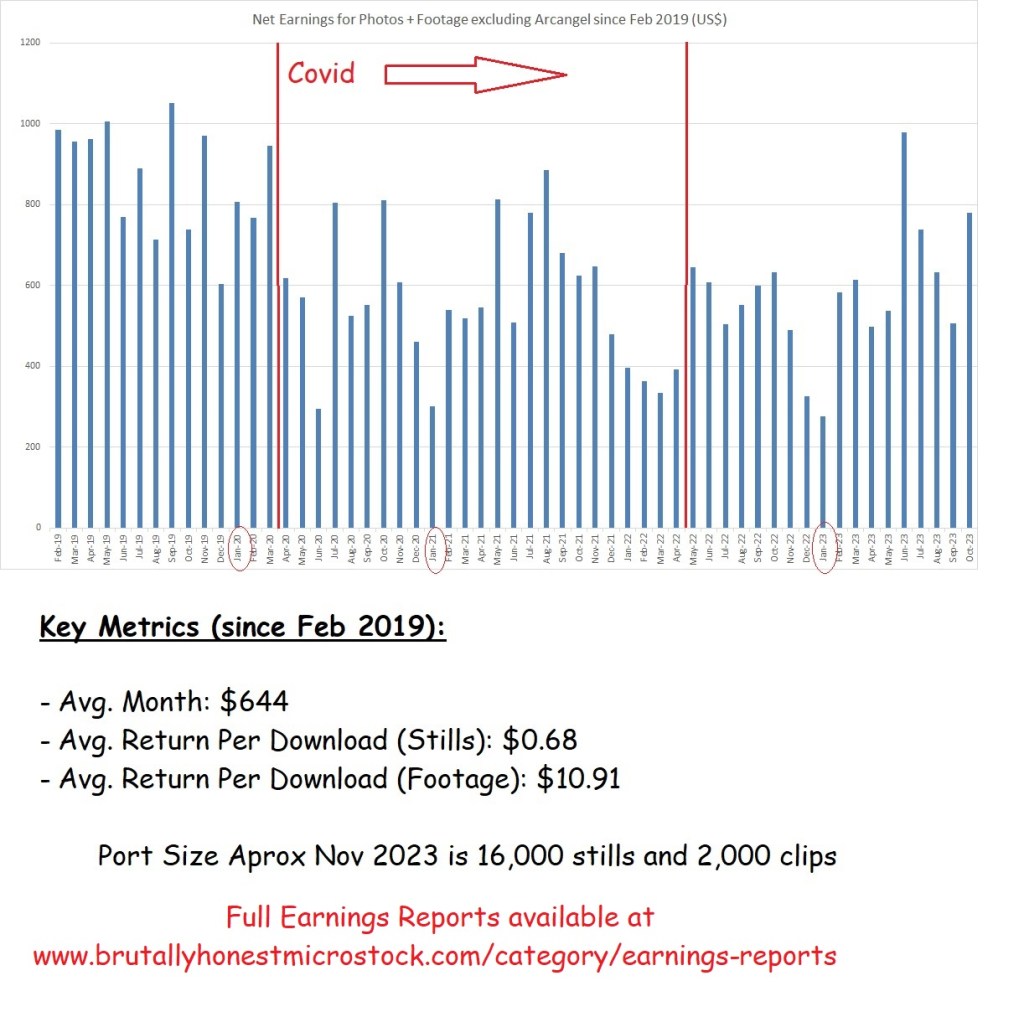
Finding it super interesting that since Shutterstock’s 2020 announcement, you can see how badly I’ve performed at the beginning of years since while I again have to climb up the tiers.
Also, seems like Covid had quite an impact on earnings since things were looking quite nice and even ticking upwards slightly before.
A boring yet fundamental note on inflation
We cannot consider average returns without considering inflation, which has been rampant since 2021. A quick research on approximately how much inflation has risen since 2013 I checked the “US Inflation Calculator“, which indicates to me the following:

We don’t all live in the US but let’s use them as a benchmark.
Therefore, in 2015:
- Stills: a RPD of 62cents/download is after considering inflation 46cents in 2023
- Clips: a RPD of $15/download is after considering inflation $10.50 in 2023
Conclusion
My trend line, unlike Jamo’s is pretty much flat!
Interesting to see that stills and footage results have the opposite problems. On one hand, stills show a worrying decrease in the number of sales (despite regular uploads). While on the other hand, footage is seeing a catastrophic drop in average sale prices (as volumes are picking up), especially when considering inflation.
What can be done to mitigate such poor results?
Not much I’m afraid other than pray.

But seriously, I’m just trying to squeeze some money from my existing port for a few years before this whole industry completely collapses (perhaps due to AI or other unforseeable reasons such as further “Exciting News”).
I’ve earned some $60,000 already from microstock which is a fair result (I don’t do this full-time nor will I ever as just not worth it), if I can somehow earn an extra $30,000 in the next 5 years, that would be a huge success for me.
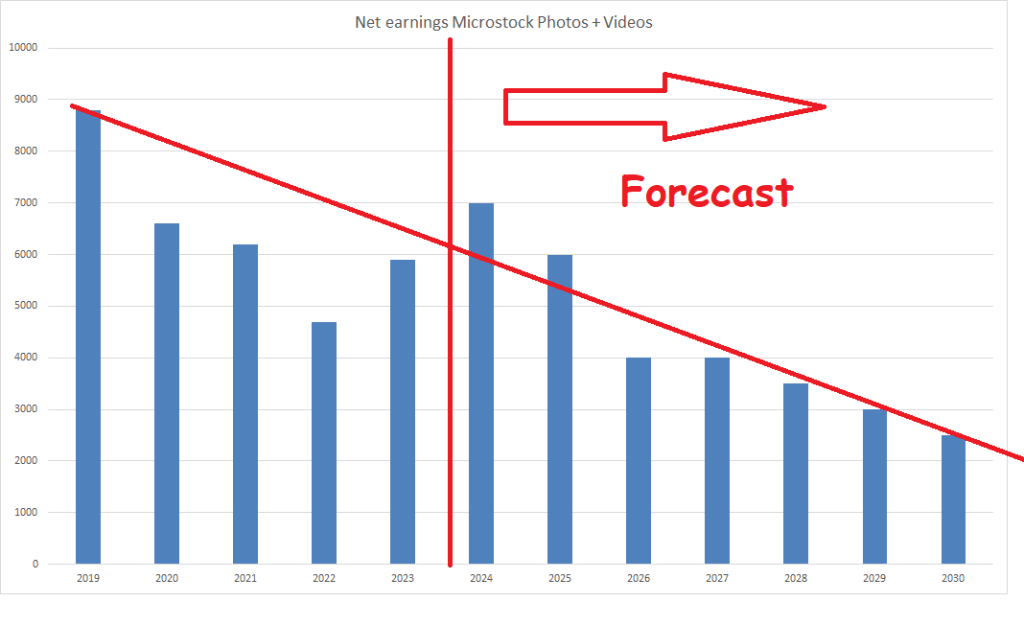
It will easily help me cover my travel and gear upgrade costs and help me pay my rent. Then after year5 (2029) once I earn only a fraction of the glory days, it’s still OK I suppose as I’ll have moved onto something more worthwhile, will be receiving some monies from my PayPal account without expecting anything and that’s the best feeling!
It does help that I live in a relatively low-cost location (Portugal), so even $1,000 a month goes a super long ways (minimum wage in Portugal is $800). If you live in a more expensive place, I’m afraid that microstock $ won’t go too far.
Microstock is far too unpredictable as a business
The reality is that this business is far too unpredictable, including the AI-generated stuff. Who knows if AI-contributors may be putting themselves at legal risk in the future at the very worst or at the very least rules change they ports are deleted.
Imagine if this were a real business, let’s say a flower shop and this flower shop is trying to make some business plans for the next two or three years. Now, with monthly variations of upwards of 60%, how can this flower shop ever think about investing in new equipment, premises, stock, staff, etc. Just far too risky.
In the same way that I’m not going to pour considerable amounts of investment into something, including gear/travel/time that in a years’ time I could be earning just 25% of what I earn now. This can sound extreme but it’s totally possible as AI-generated content makes headway.
So is there anything optimistic I can draw from the stats I’ve drawn? Well, if you’re considering joining, don’t and if you’re already far too deep like me, try to use the skills gained creating microstock content to work directly with clients…or specialize in something that has potential longevity. I’m going all in with book covers and drone footage. Microstock is really just a waste of time going forward for me.
On that pessimistic note, I will leave you and hope you’ve enjoyed me running through some of my numbers. Until next time!
About Alex
Meet Alex, a self-proclaimed eccentric wanderer, desperately clinging to the fading glory of a dying microstock industry. Nestled in the melancholic ambiance of Lisbon, Portugal, Alex embarks on a futile quest to explore the farthest corners of a world that no longer values the once-thriving business of stock images and footage.
Eight years of dedication to the forlorn cause of being a travel photographer and videographer have led Alex down a desolate path. The once vibrant and promising landscape of microstock has withered away, leaving him with a portfolio of images that echo the fading pulse of an industry gasping for its last breath.
In a last-ditch effort to salvage something from the wreckage, Alex has thrown his creative soul into submitting book cover images to Arcangel Images, an act akin to casting messages in bottles into a vast, indifferent sea. The purchase of a DJI Mavic 2s drone serves as a desperate attempt to grasp at the technological straws, capturing moments that few care to purchase in a world saturated with visual content.
The mention of a potential acquisition of a Mavic 3 is nothing more than a fleeting hope in a realm where innovation struggles to breathe. It’s a feeble investment in a future that looks more and more like a grayscale image, devoid of the vibrant hues that once characterized the microstock industry.
Alex’s pride in having written a book about his adventures feels like a tragic memoir of an era long gone. The “Brutally Honest Guide to Microstock Photography” reads like a eulogy for an industry that once promised creative liberation but now lies buried beneath the weight of oversaturation and apathy.
In this bleak narrative, Alex’s journey serves as a cautionary tale, a testament to the harsh reality that even the most passionate pursuits can crumble in the face of an indifferent market. The unique insight he sought to provide now mirrors the bitter truth that the microstock industry, once a beacon of creative entrepreneurship, has become a graveyard of shattered dreams.
 Alexandre Rotenberg's Brutally Honest Guide to Stock Photography & Footage
Alex! I always read this brutally honest stuff with interest.
I laughed at the last sentences about “don’t”!!!! join microstock!
I am in a really poor mood today [not because of your post!!!!) – and your post made me laugh!!!
What I notice in your journey is called “PERSISTENCE”… and this is the key to success!
You have earn some pretty money and besides it gave you lots of experience in photography and in client communication.
I totally agree that this business is unpredictable since we have NO CONTROL over it. The only thing WE CAN control is by shooting pictures PEOPLE WANT and this is – microstock – great training ground!
With my pretty bad mood today [bad mood happens to me when I try new business approach with little control over new contacts] after reading your insight I feel very very much agitated to get to work tomorrow!
BTW. I used today the tool you mentioned:
Microstockr
I have found it might be helpful yet I discovered some agencies they list like BigStock no longer accept new contributions. You are some kind of authority in the community so I ask you to contact them [microstockr] and make them update the list.
Your big FAN
Robert
LikeLiked by 1 person
Hi Robert,
Thanks for being my fan and your great comments!
Hope I’ve improved your mood…writing this blog post also improves my mood and seeing my great “good old days” pre-2020 results brought me back some nostalgia.
Yes, persistence is def key. I’m a super stubborn guy and perhaps it’s my downfall on some occasions but I think in this business it’s paying off somewhat and really paying off at Arcangel with book covers (when I was getting 90%+ rejections pre 2021).
I’ll investigate why Bigstock isn’s loading on microstockr, I don’t upload to Bigstock anymore since SS turned them into a giant dumping ground.
All the best!
LikeLike
Thanks Alex for sharing and mentioning my Medium blog! Stats are always interesting.
Honestly, I don’t really see a bright future in traditional stock photography either, except maybe if you focus on shooting people. In my experience, heavily photoshopped landscapes and 3D renders are the ones that sell, not so much the photos in my portfolio.
My approach to stock photography has always been quality first and quantity second, which is probably why my portfolios have been growing at a slower pace. But so far, it’s paid off.
However, lately I’ve noticed a drop in my image downloads. Maybe it’s time for me to start reporting declining earnings too. We’ll see how it goes…
LikeLike
As always, a very interesting post. After your years in the sector and knowing that you do continuous work uploading images, it is very important to know your results, because they show what situation this business is in from the perspective of an average contributor (leaving aside the large ones). The graphs give a lot of information regarding the microstock situation. I would not recommend anyone to start in this world of microstock either. I even have the feeling that I am in this industry only out of inertia after having been in it for a while and also because I don’t have another way of life for now. Maybe that inertia will end up losing steam at some point.
LikeLiked by 1 person
I don’t know. Some year ago we where predicting tha this business will evaporate. And it didn’t. I think it’s maybe because, fundamentally SS fcked the business model and started paying creators pennies. With Adobe for example, I’m making about 200$ with a portfolio of roughtly 500 vector and png images. (It’s not silver spoon content at all). Ai did impress me, but as a client who is in need of some custom graphic resources, I needed to put so much imput I got frustrated and I quit useing it. It’s only good for small editing, but it does not replace graphic design.
So, maybe our pessimism is mainly because we overstimated AI and belived that SS is the best business model for microstock and beleved that we can make a living out of this. It’s not. Also, most our our buyers are afraid of copyright infragments, not necesarily because they cannot get it for free. And these laws are getting more and more tight.
Heads up, It’s goood pocket money!
LikeLike