Interview with Annie from Milleflore Images, Food Photographer & Author
Continuing on with this blog’s exclusive interview series, today we’re speaking with Annie from Milleflore Images, a food photographer (link to her Instagram), educator, and author whose work and teaching have shaped how many newcomers approach the craft. With experience spanning business consulting, graphic design, microstock, premium licensing, and now a popular “Delicious” book series, Annie combines creativity with a sharp, analytical approach that helped her license over 200,000 images and videos.
As one of her favourite quotes is: “The world doesn’t need another copy – it needs YOU” by Tal Gur, let’s dive straight into the conversation and get a sense of her unique style.
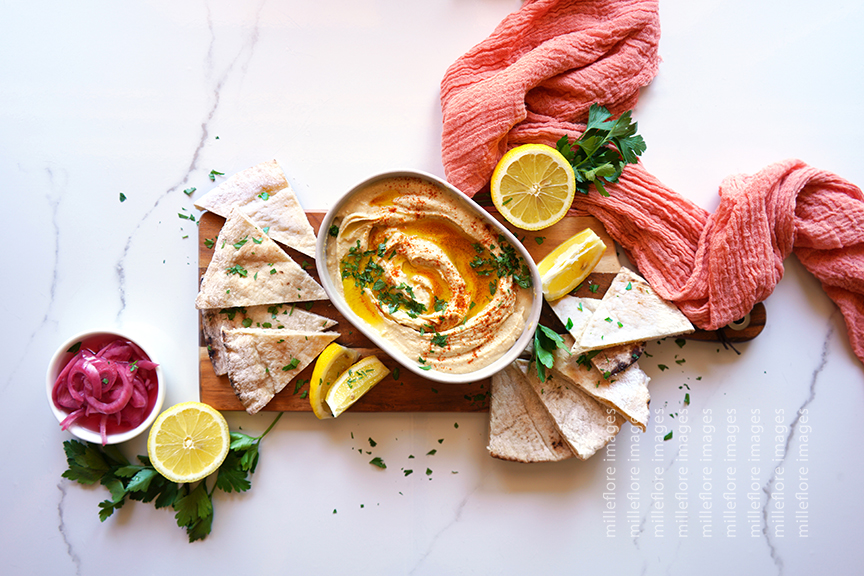
Chickpea hummus served with olive oil, pickled red onion, lemons, and flatbread on a white marble table background. Top view flatlay.
Background & Beginnings
Hi Annie and welcome to the blog! What first drew you into food photography and stock imagery? Was there a particular moment when you realised this was your path?
Hi Alex, pleasure to be here!
When I finished my photography course back in 2012, the school also offered an advanced course specializing in food photography, which I enrolled in. At the end of that course, our teacher told us about stock libraries and how you can sell your surplus images from photo-shoots there, with the client’s consent of course. That was how I first learned of stock agencies.
As for food photography, I guess it’s always been in my blood. My father was a chef, I love cooking and making up my own recipes, and always looked at food preparation as a kind of art-form. Plus, it is so versatile. All the different types of food, the colors, the textures, the richness. You can never run out of ideas and subject matter, in my opinion. You can even grab a pumpkin and photograph it 10 different ways, which I now include as a practice session in my Delicious Styling book.
During my years in Microstock (2013 to 2023) I specialized in holidays, and that’s where food also plays a big role. Also, from my own observations, the photographers who have achieved a certain level of success as well as longevity, seem to have a certain love or passion for their subject, whether its travel, animals, capturing the spontaneity of street photography, or cooking. I think that is the key.
On your “About” page you mention over a decade of experience. How has your background in graphic design, teaching, and business shaped the way you shoot, package, and market your images?
Oh, where do I start? Yes, I have had 3 careers. The first was as an accountant and business consultant. One of the main ways we analyse a company’s performance is through Ratio Analysis, which is by measuring and comparing ratios from its financial reports. When I started stock photography, I set up a simplified system of that to monitor all my sales and then taught some of my friends how to do it as well. People often ask me how did I sell so many licences and that is definitely one of the main reasons. I eventually knew as much as possible as to what sold best, what subject, what category, and right down to what colors. And that told me what to shoot. (Yes, you can take the girl out of accounting but, etc, etc.) I did a lot of teaching concurrent with my business career. I taught accounting part time at Melbourne Uni, I ran user group training sessions for new system implementations, and public workshops for personal finance management. So I decided to study teaching through Train the Trainer courses, and that taught me how people learn, the different types of learners, and the most effective ways of teaching. That has now helped me with my books, which are purposely high on visuals and low on text, because it is the most effective way for people to absorb new information.
Understanding the marketing side of business has been invaluable to me as well. The trouble with marketing is that many people confuse it with just selling. Many contributors quite rightly think why should I promote my products when I’m using an agency. But the selling part is only a fraction of a marketing plan. Right from the start I also set up the basics of a marketing plan for what I wanted from stock photography, which included setting goals, finding your target audience, analysing the market, yourself, your competitors, etc. That is why I devoted a whole section in my book, Delicious Photography, to marketing. It is critical in determining what to shoot.
Whenever I start a new venture, I always set goals. Then I forget about them and just follow opportunities and ideas as they flow in. Recently I found my original plan for starting stock photography and I smiled. One of my goals was to earn a minimum $1,000/month, which I thought was far too high at the time. Then I went and checked my past income stats, and found that I had earned $911.97 in April 2013 – just 4 months after I first started uploading. I then went on to double that, and triple that, and 200,000+ downloads later it was time to change. But it wasn’t me or any spectacular images I produced at that time (just the opposite). It was the system I set up.
Graphic design was my second career, circa 2009 to 2012, something I always wanted to do back when I finished high school, but my parents talked me out of it, and instead I studied business at uni. But I was working too hard, too many long hours during my business career, and illness forced me to stop and do something else. So, finally I could follow my heart and study graphic design. Knowing the basic elements of design has been invaluable to me and essentially taught me how to style, which is how I teach styling now. Many people think they can’t style but I believe everyone can, once they know the science behind it.
My third career, photography and now books, draws on all the above. I consider myself very lucky to have had those opportunities and experience to draw from.
You mention your father was a chef and that you’re “a total foodie.” How much does your love of food influence your approach to styling, lighting, mood and storytelling?
The best way to answer that is by quoting the dedication of my first book:
“To my dad, a talented artist, an innovator and a photographer. My father was a chef and I often recall the first time I asked him to teach me how to cook. It went something like this:
Dad: Put some butter into the pan.
Me: How much?
Dad: Enough.
Me: ?????
Yes, very confusing for a young 10-year-old girl. Of course, what he did teach me was to feel the process and that has assisted me all these years, not only for cooking but eventually for my photography too.”
To me, that says it all. My dad taught me to feeeeeeeeeeeeeel the food. And that influences everything. When I style I know when it’s right and when it’s not quite there. Sometimes it can take me 10 to 20 shots, but when I get there, I know. I can feel it. The same with lighting, mood and of course, that is also the heart of imagery storytelling. But it’s a very difficult thing to teach, especially to beginners. So I teach them the science behind all those things, and eventually encourage them to start developing their own style … and that’s when they start to understand the feeling side.
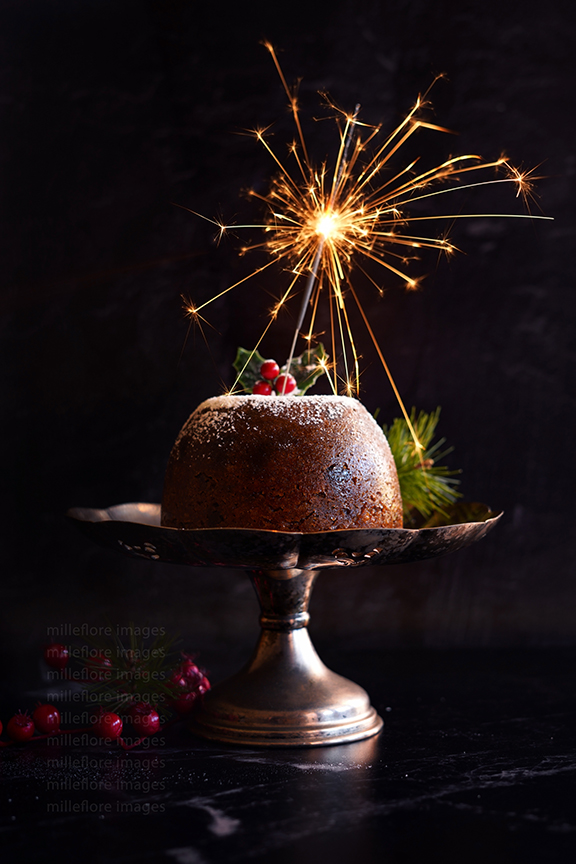
English style festive Christmas plum pudding dessert against black marble background.
What’s your favourite type of food to cook and then shoot and why?
Everything and anything. I have no favourites per se. Creativity to me comes from variety, embracing change and trying new things. I normally work on a similar type of photography for as long as it takes to learn from it and master it, and then I move onto the next new thing.
Your website says: “when they zig, you zag.” What does that mean in practical terms for your photography, and how do you translate that into stock-ready imagery?
When I started stock photography, I looked around at what was on the databases. Back then most of the top sellers were glossy photos shot against white and neutral background, so I shot all these simple things on bright colored backgrounds. When I look back on my original portfolio, I cringe. The photos themselves were not very good, but it worked at the time.
Even today, I still do it. When AI came in and a lot of contributors plunged themselves into producing AI imagery, some with a lot of success, I went the opposite way. I went premium real food photography. As prices for Microstock images came down, I went up.
I studied all the latest food photography styles and read a lot of the current top selling books on the subject when I first started with the Picture Pantry. The popular style now is what I call ‘Millenium Grunge”. It has a softer but overall darker look against very grungie backgrounds. It highlights textures beautifully but it has very low dynamic range. From my stock photography background, I knew that what stands out on crowded search pages and fast scrolling social media feeds are always photos with high dynamic range. This is what the subconscious eye sees as appealing, and grabs the viewer’s attention, so I went the opposite: strong dynamic range. It was a risk and I felt nervous at first going against what all the foodies wanted to learn and mimic, but it paid off. Not only with more Instagram followers and book sales, but to my surprise recently winning Bronze and Honourable Mention awards in the 1839 Awards International Photographer of the Year Contest. That really floored me. When I entered the photos on a whim, I nearly removed them later thinking I was going to make a fool of myself.
I know from teaching, that beginners will naturally copy others when they are learning, but in this competitive world that is where they can go wrong. They have to do the opposite. You have to experiment and keep trying until you find something that is NOT what the top people are doing. I know it sounds simple, but not necessarily easy in practice. When I plan my photoshoots for stock photography, I look to the database first, and then go and think of something that is NOT there.
“The world doesn’t need another copy – it needs YOU” by Tal Gur is one of my favourite quotes.
Where do you draw inspiration from? If you’re comfortable sharing, which photographers, magazines, or communities influence your style?
Inspiration can come from anything or everything. Cookbooks, magazines, your evening meal, something you see in a movie, and it doesn’t need to be that particular food or dish – it can just give you an idea for something else. Also, what is popular on social media but not covered on stock databases (surprisingly, that happens a lot!). Even from my kitchen, pantry or garden. I grow my own herbs and edible flowers and that gave me the inspiration for my last shoot. Eg ‘what can I do with my new viola flowers’? But as I said above, I really try to avoid doing what other photographers are doing.
Communities offer support and can show what’s on trend. Knowing the latest trends is very important to keep your work up-to-date, relevant and sought-after by buyers but the key is to keep it classic and adapt it to your own style.
Books & Courses
You’ve released a full series: Delicious Photography, Delicious Styling, Delicious Editing and Delicious Marketing. Which came first, and how did the idea evolve into a complete set?
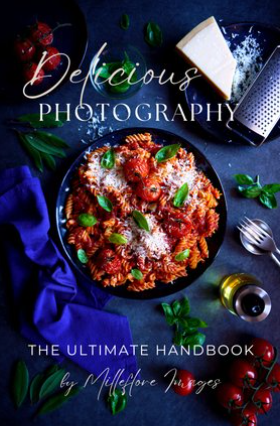
The first book was Delicious Photography, The Ultimate Handbook, which evolved from my blogs and photography, styling and lighting tips on social media. They started to become popular and I developed a following, which then led to the book.
In marketing, one of the ways to maintain book sales is to offer a series. In my case, I took sections of the first book and expanded each one out with more information to become its own book.
What are the most common mistakes beginners make in food photography that you frequently address in your books and courses?
Not knowing their target audience.
Knowing your target audience affects just about EVERYTHING you do. From what to shoot through to keywording and SEO optimization, what social media platforms to use. Everything.
I know I’m supposed to say, lighting or styling. Yes, beginners have problems with those. But these areas can easily be learnt. But if you’re producing the most glorious, scrumptious food images, and they are not selling then you either have too much competition and you have to niche down, or you have to find your target audience, and go where they go to buy their photography. Do you change to a premium agency, sell direct, sell wall art (food photography is very popular for that)? All this should come out when you fully analyse your target market.
But just a warning, premium agencies are not easy to get into. The rejection rate is high. If you think you have or produce what they want, keep trying and keep upping your own game. Think like the agency, try and find who their clients are, and see if you can match that.
Editing and marketing often feel like afterthoughts for many photographers. Why do you place so much emphasis on these areas in your teaching?
Yes, you’re right. They do feel like afterthoughts for many. I have yet to fully understand why. Sometimes it’s like pulling teeth to get them interested in those two subjects. Styling, styling, styling. Everyone wants styling tips. I guess styling is the ‘sexy’ part of food photography. Editing is the boring part. And for some unknown reason, they just skip right past the marketing.
But at the same time, they come to me and say, I just love your images, they are stunning. Occasionally I show my images straight out of the camera – and how boring they look. I don’t advocate too much editing, that can ruin an image, but knowing how simple things like increasing highlights and shadows can totally change an image (by widening its dynamic range) is a very powerful tool to have. And marketing, yes absolutely critical – for all the reasons I mentioned above.
AI threat or opportunity?
How do you feel about AI in food photography, more of a threat, an opportunity, or a bit of both?
I added a page at the end of my first book about this where I said:
“With specific regard to food photography, AI finds it difficult to reproduce light and shadows. It also ‘produces unnatural smoothness where there should be texture’. Light, shadows and textures are the cornerstones of what makes food images look delicious so, for now at least, your genuine food-scrumptious pics should be safe.”
I am yet to see one AI food photo that doesn’t look fake on close inspection, but I guess everything has its market. Those buyers who need high-end photos for magazines, cookbooks or billboards and willing to pay for them, probably go to the premium agencies now, especially if there are too many AI food photos on the Microstock agencies’ databases. It’s too confusing for them and difficult to wade through.
Trends, Tools & Technique
What is your go-to gear for shooting food photography and videos?
I use the Sony A7R series cameras, mainly because they are very light and I have very narrow wrists. This is important for me when shooting handheld. Plus a very good tripod for all the other shots. The tripod needs stable rubber footing, with a centre post that can be extended at right angles for overhead shots, and good payload to balance the weight of the camera. This is also where the Sony’s light weight comes in handy.
I have put away all my studio lights. Haven’t needed them for a couple of years now. I just need a large window now as all my food photography for The Picture Pantry is shot in natural light. Plus 2 tables. One is an ordinary 4 seater Breakfast table from Ikea that I’ve had for years. And more recently a large camping table that is portable and has 3 adjustable heights. Plus a couple of diffusers and reflectors.
For lenses. I have a zoom, 2 primes: 50mm and 35mm, plus a macro. All Sony lenses. I looked at tilt-shift lenses last year but couldn’t find exactly what I needed, so I got the camping table instead. That lowers the composition and prevents fisheye distortion when shooting wide. It was a very inexpensive solution.
When styling a food shoot for stock, what’s your single most important tool, prop, or element for elevating a scene?
The food itself. For example, one of things I teach is how to style for the three main camera angles. Each one has a specific purpose and each one is styled differently with different use of props and backgrounds to convey that purpose. But essentially it is the food that determines that purpose and has to take centre-stage.
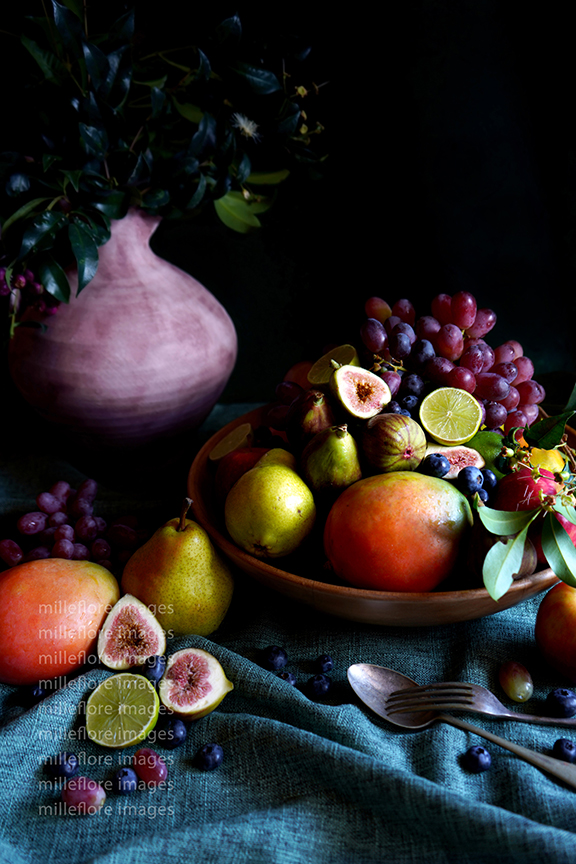
Seasonal Autumn Fruit Bowl with Apples, Pears, Mangoes, Figs, Limes, and Grapes.
You also offer more than 3,000 videos. How have you adapted your workflow for motion, and what advice do you give still-photographers who want to transition into video or stop-motion?
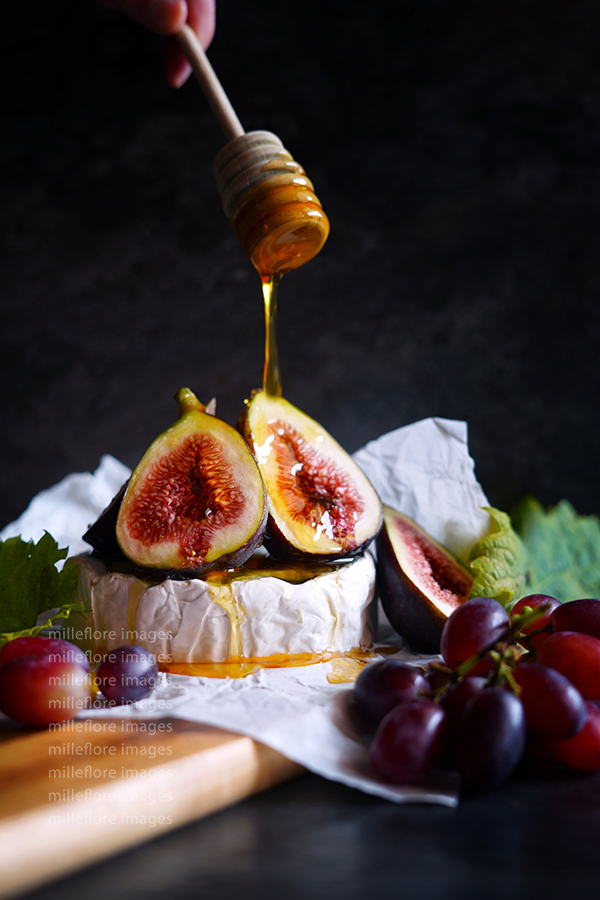
The basic principles of what makes a delicious looking food image is the same for video. i.e. accentuating textures, mouthwatering colors, and adding authenticity to help evoke viewer’s memories. But with video you can add the actual action through dripping syrups, runny sauces, and using hands reaching, serving, or holding the food. It’s that light that glistens on the honey dripping onto pancakes that makes it eye-catching and yummy looking. That’s what you have to capture.
What’s one counter-intuitive lesson or “hard truth” about food photography that you wish more beginners understood?
Don’t follow the crowd. (Adapt trends to what resonates with you. Takes time but that how all social influencers and leaders became the leaders.) Also, ask yourself before you shoot, what is it exactly that makes this look interesting, appetising or delicious. And then shoot that. As in my example above: it’s not the honey, it’s the light glistening on the honey. Don’t aim to be a great photographer. Aim to be a great observer.
Brie cheese served with figs, honey and grapes. Female hand drizzling honey.
Looking ahead, what’s next for Milleflore Images, any new books, courses, or shifts in your creative-business model you’d like to share?
I am looking at possibly online courses for next year. I am on a three-year contract with The Picture Pantry to provide monthly uploads, so I will still be shooting for them. Other than that, I have had a very busy year in 2025 and looking forward to a more relaxing one next year. I turned our courtyard into a Zen garden this year, and I just want to spend more time sitting in that.
Thanks for these are really great questions, Alex! PS: you’re very good at this
Thanks Annie for this great opportunity and wonderful insight, which was the cherry on top of my week of traveling in Spain 🙂 Now, all this talk has made me hungry…
About Alex
I’m Alex, eccentric, based in Lisbon, and on a mission to explore every corner of the globe while capturing stock images and footage along the way.
For the past 12 years, I’ve been grinding as a travel photographer/videographer and freelance writer. Along the way I’ve also written The Brutally Honest Guide to Microstock Photography, a book packed with war stories and practical tips for anyone crazy enough to enter this business and more recently, The Brutally Honest Guide to Drone Laws in Europe.


 Alexandre Rotenberg's Brutally Honest Guide to Stock Photography & Footage