Four Years on, follow-up Interview with Adam Melnyk, Drone Pilot
Wow, time flies – it’s been over four years since I first interviewed Canada-based, Adam Melnyk and suffice to say that he’s no longer a novice, as the original interview was titled.
Adam is back to catch up on how his stock business has been progressing including discussing his top five best-selling drone clips and providing us with some tips for those looking to sell their aerial stock content. Let’s get started!
Hi Adam and welcome back for an update interview at the Brutally Honest blog!
You must be equally amazed at how much the technology has evolved over four years – what drone are you shooting with now and why? Are you eyeing any upgrades soon? Personally, I’m loving the specs of the Air3 as the 70mm lens looks awesome.
Thanks, good to be back!
My first drone was the original Mavic Air, which I had for four years. In 2022, I upgraded to the Air 2S, the same drone you have. In comparison, this drone is light-years ahead of the previous version. From the much more reliable signal of Occusync3 to the larger sensor and better overall image quality, the drone is a massive improvement in aerial videography. I couldn’t be more pleased with my decision to upgrade. It’s worth noting, my old Air was still in good working condition and I was able to sell it for a decent price.
While the early reviews of the new Air3 seem to be positive, an upgrade is quite a ways off for me since I just purchased a new drone last year. Most likely, the series number will be the Air 5 by the time I decide it’s time to upgrade, haha!
Since the last interview, your footage port “aerials only” at Shutterstock now stands at 1,350 and around the same quantity at Pond5. How consistently do you upload and do you have any tips to optimize your workflow, including post-processing and keywording?
I upload between 30 and 100 videos a month. Sometimes, there are months when that does not happen due to client jobs and other commitments.
Overall, as you know, stock is fairly time-consuming. I try to silo stock concepts I see/come up with to a list. Then, I try and focus on one or two concepts in a day to capture the idea as best as well as I can. I use Premiere tags to sort and eliminate videos, in addition to using Lumetri presets for color correction.
To be more efficient, I have also started keywording videos while exporting.
Now straight to the juiciest question of all, how much are you earning on average from your drone clips?
My monthly total average is around $600.
My aerial footage clip earnings are approximately $8,000 since the beginning, so I have easily been able to pay off my investment and earn a profit.
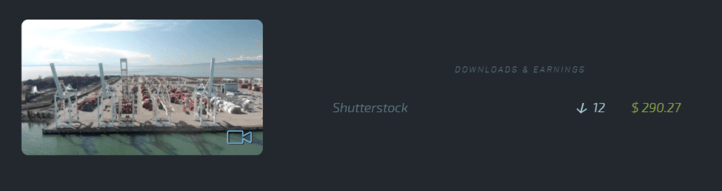
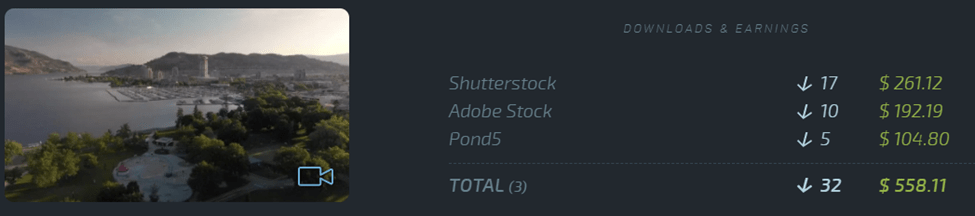
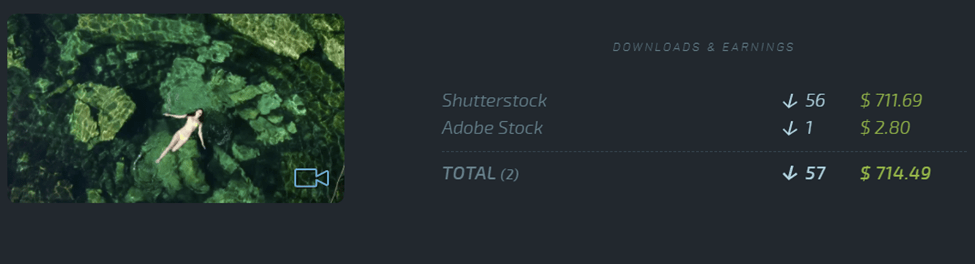
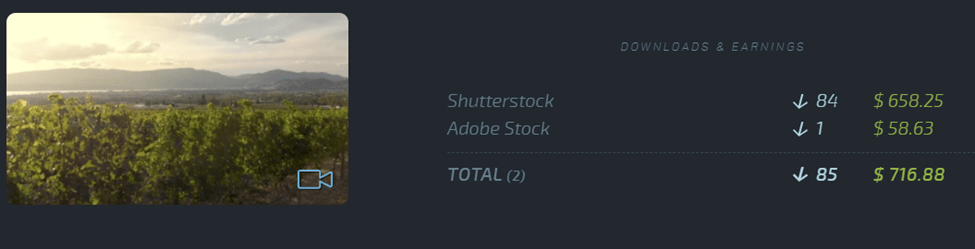
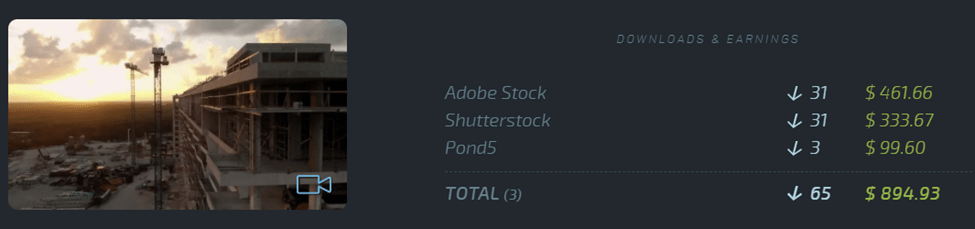
As you’ll see below, almost half of my total earnings have come from just five clips.
Great result, Adam! Would you kindly share which are your best-selling five drone clips and why do you think they’re regularly being selected?
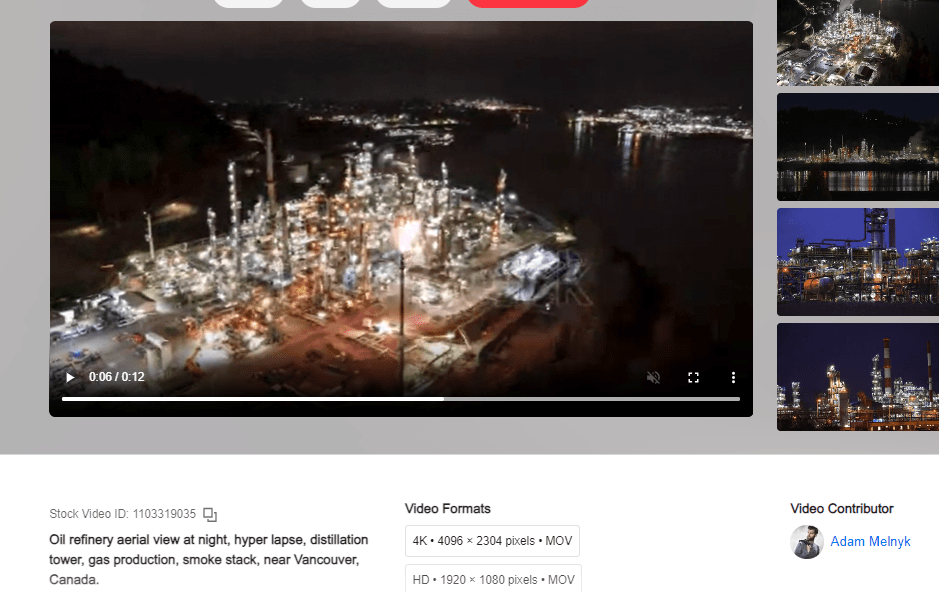
Sure, here they are, starting with the 5th.
And the number one is….
As for why I think these have sold well, obviously, there is some degree of luck involved. A clip gets picked up which allows it to rise the search ranks thereby increasing its chances to get picked up again; a self-perpetuating cycle.
If I had to guess what makes these clips desirable it would be relevant subject matter and in-demand niches, and the purity of focus on said subject. This means the subject is clearly highlighted and occupies most of the frame with minimal, or no distractions. Good light is present in some of the videos mentioned, so I would say that is a factor. I would also say that video quality, including proper color correction, is necessary.
One last observation is that the camera movement is only on one axis for most of these best-selling clips, which indicates clips should be kept fairly simple.
Which agencies do you upload to and what are your best-selling agencies?
As you can see from the above results, there are only really three agencies that are worthwhile IMO; Shutterstock, Pond5, and Adobe. I don’t bother with iStock as they were racing to the bottom before it was fashionable. As seen from others’ video sales, they have plenty of small subscription sales that SS and AS have, without the larger clip pack sales. The same goes for smaller subscription/volume based ‘screw the contributor’ type agencies like Artlist.
I don’t contribute to the ‘pie in the sky’ boutique agencies that sell footage for huge prices that require exclusivity. My footage is good, but I don’t think it is on the level (technically or artistically) for a major production to pay a serious premium to acquire it. For the most part, I think these types of venues are pipedream agencies that aren’t facing the reality of today’s industry and of consumer interests.
A disclaimer; I would always recommend anyone planning on flying their drone at night obtain the proper authorization and take adequate precautions before doing so as it carries many risks.
The main concept to adhere to when flying at night, and in general, is to maintain good situational awareness. If you are not familiar with the area, scout it in the daytime to assess obstacles that may be in your flight path. Most of the time, you will be flying in areas that are well-lit by artificial lights, so seeing and avoiding hazards should not be a huge issue. With that said, when maneuvering at night (when not shooting), turn the camera mode to photo and set the ISO to the highest level. This will give you a much better view of your surroundings.
In any event, I would stress taking extra caution and care when flying your drone at night...and even during the day.
Great advice – staying on the topic of risks, have you ever had any “close calls” flying your drone, tell us what happened and any lessons learned.
I did have an accident with my old Mavic Air, but it survived the crash to fly another day. Had a few other minor close calls, and run-ins with some ‘block watch’ types, but for the most part drone ownership has been clear skies.
My main advice is just to maintain situational awareness. From the type of airspace overhead to the area you’re flying in, always keep your eyes open and take a look around. In relation to that, if you are going to fly in a direction other than forward, I would always double-check the area is free of obstacles, even if you have obstacle detection.
Great advice! Sticking to time-lapses / hyper-lapses, in your opinion, are they worth the time and effort for the returns?
In terms of aerial hyper-lapses/time-lapses, I have only been seriously doing them since 2022. The results have been fairly limited, with only a few sales. I am going to continue creating them, with more focus on marketable niches, and simple, but focused composition.
I will re-evaluate their ROI over the next year to judge whether I should continue putting effort into making them.
May you share an example of a challenging aerial shot you’ve captured for stock footage? How did you plan and execute it successfully?
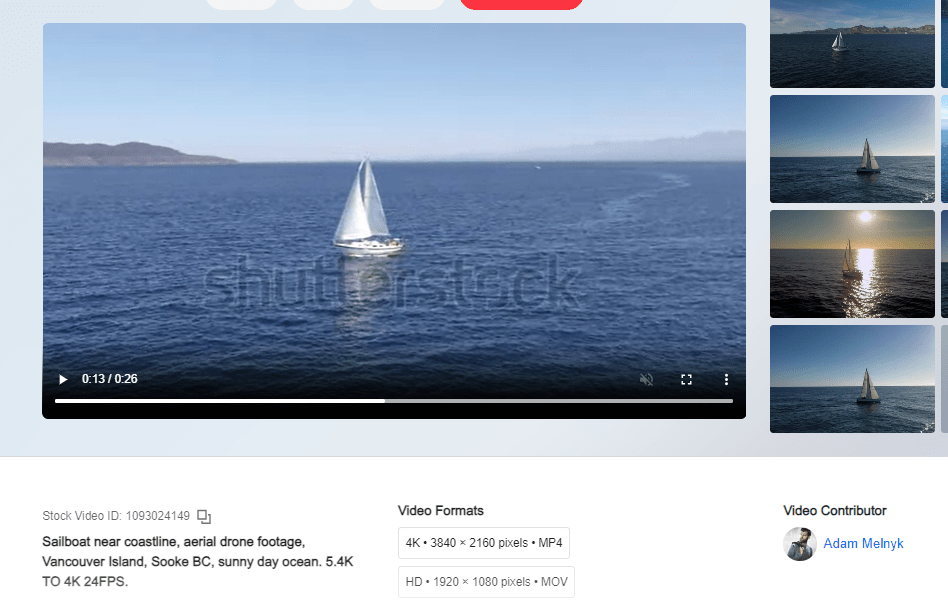
I would have to say manually doing a flyby of a sailboat while keeping it in center frame and while the drone was moving in a singular direction. This created a sweeping cinematic feel to the shot. While some FPV pilots might scoff at me calling that challenging, I did find it tested my coordination and finesse on the sticks to execute it smoothly.
Normally, one might do this move using Active Track, however, that feature is not available on the Air 2S when shooting in 5.4K and therefore needs to be done manually.
There wasn’t any planning that went into the shot. I just saw the boat and thought a cinematic fly-by orbit would look good. To execute, it essentially requires you to rotate the pitch/roll sticks from a forward direction, through a sideways direction, and finally, a backward direction, all while yawing the drone to keep the subject in the center of the frame.
Super smooth shot, well done. What are your some of your medium-term goals (let’s say the next 5 years). Perhaps you’re interested in putting together a stock drone footage course for newbies?
I will continue to capture relevant subjects and keep my eyes open for concepts or executions of concepts that I think might be profitable. I also have created a ‘to-shoot’ list of subjects I have come up with or seen, and will consistently work through that list whenever possible.
I am considering creating a course to help those that are new to the subject get started and find their footing. Sharing my knowledge and experience might also be of value to those already established.
How would you advise newbies that may be considering capturing drone stock footage? Is it too late to join the race?
Keep in mind, you’re not going to get rich doing this, so if you are planning on purchasing a drone for stock, look at the more reasonably priced options.
In addition, do learn everything you can about the features and functions of your drone, and practice flying smoothly.
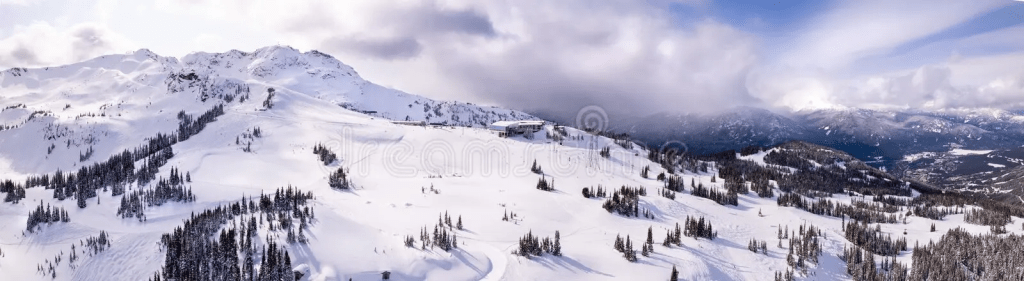
I wouldn’t say it is not too late to start. If you already have the equipment you might as well put a little effort into posting the footage that you may capture on a ski trip, for instance. It only takes a few good clips to generate the majority of your stock income as disclosed earlier.
What are your thoughts on AI developments for footage post-processing. Do you find it useful or do you stick to your guns and don’t use it much?
I learned to edit video myself, so I will just stick to that for the time being. Recently, I have been using GPT to keyword, and that has been a huge time saver.
I have been using The Top Shelf for the past two years and it has been a serious asset in terms of making my photography/videography workflow that much easier. The convenience of having a bag that allows you to instantly access all your gear, all without the need to set the bag on the ground, is an absolute game changer.
It allows me to seamlessly swap out gear, and also to put my camera away quickly in those ‘in-between’ situations when I know I will be shooting fairly soon, but not immediately, and don’t feel like having to carry my camera in hand.
Another benefit it provides is acting as a platform to set up my drone and to rest the RC on. This has come in very handy while I have been shooting while skiing.
In my humble opinion, the utility and convenience of The Top Shelf is unparalleled in the world of camera bags. If anyone is interested in getting their hands on this bag, you can do so here.
Thanks, Adam and wish you continued success – hope to catch up with you in a few years to see how you’re getting on with your new Air5 that shoots in 12K with a battery life of 3 hours haha!
About Alex
I’m an eccentric guy, currently based in Lisbon, Portugal, on a quest to visit all corners of the world and capture stock images & footage. I’ve devoted eight years to making it as a travel photographer / videographer and freelance writer. I hope to inspire others by showing an unique insight into a fascinating business model.
Most recently I’ve gone all in on submitting book cover images to Arcangel Images. Oh and also recently purchased a DJI Mavic 2s drone and taking full advantage and perhaps an Air 3 soon.
Thanks, Adam, it would be interesting to take a look at the course if it will come to fruition.
Other than that – great clips! Really enjoyed reading the article.


 Alexandre Rotenberg's Brutally Honest Guide to Stock Photography & Footage
Thanks, Adam, it would be interesting to take a look at the course if it will come to fruition.
Other than that – great clips! Really enjoyed reading the article.
LikeLiked by 1 person